The Best Indoor Humidity Level for Florida Homes
Most Brevard County homes are comfortable at 45% to 55% indoor humidity. Learn how to measure moisture, prevent mold-friendly conditions, and improve comfort.
For most Florida homes, the best indoor humidity level is between 45% and 55% relative humidity, with a goal of remaining below 60%. Brevard County homeowners may need to adjust within that range based on the season, indoor temperature, building construction, and household comfort. If humidity regularly exceeds 60% even while the air conditioner is running, the home or HVAC system should be evaluated.
What humidity level should I set in my Florida home?
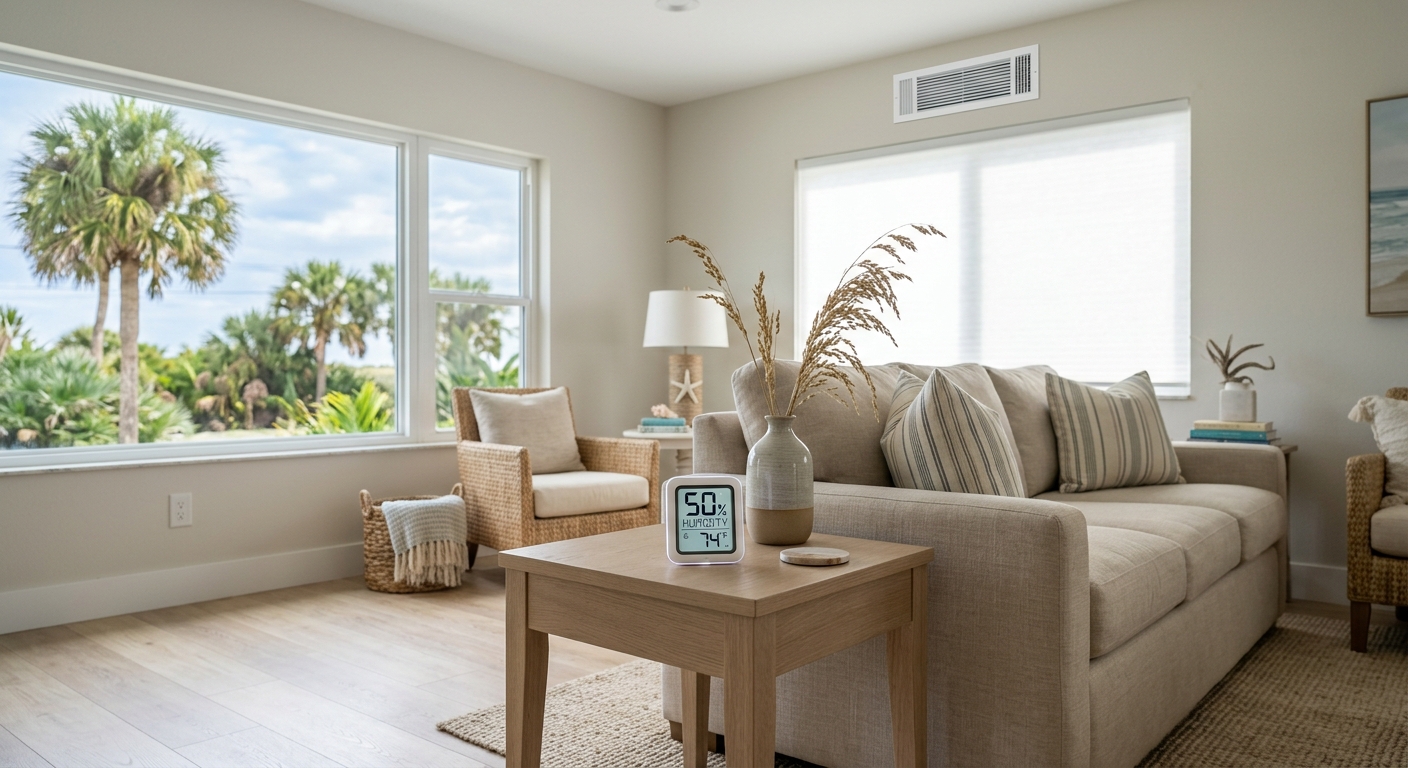
A practical target for an air-conditioned Florida home is approximately 50% relative humidity. Maintaining 45% to 55% usually provides a comfortable balance without requiring the air conditioner or a dehumidifier to remove more moisture than necessary.
Relative humidity describes how much moisture the air contains compared with the maximum amount it could hold at the same temperature. Because warm air can hold more water vapor than cool air, the relative humidity reading changes when indoor temperature changes. That is why a thermostat setting and a humidity reading should be considered together.
- 45% to 50%: A good target for homeowners who prefer cooler, drier conditions.
- 50% to 55%: Comfortable and realistic for many Brevard County homes.
- 55% to 60%: Worth monitoring, especially if rooms smell musty or feel clammy.
- Above 60%: A persistent moisture problem that can support mold growth and dust mites.
- Below 40%: Usually unnecessary in Florida and may cause dry skin, irritated airways, or excess energy use.
A brief humidity increase during cooking, showering, or an open-door gathering is not usually an emergency. The more important question is whether the level returns to its normal range after the moisture source stops.
Why is indoor humidity difficult to control in Brevard County?
Brevard County's warm climate, summer thunderstorms, coastal air, and long cooling season create a substantial moisture load. Humid outdoor air enters whenever doors or windows open, but it can also leak through gaps around plumbing, recessed lights, attic access panels, and other penetrations.
Homes near the Indian River Lagoon or Atlantic coast are not automatically damp indoors, but wind and frequent exposure to moist outdoor air can increase infiltration. Afternoon storms in Melbourne, Palm Bay, Rockledge, Cocoa, Titusville, and surrounding communities can also produce rapid changes in outdoor temperature and humidity.
Your air conditioner removes both heat and moisture. Moisture condenses on the cold evaporator coil and drains away, but the system needs enough runtime to complete this process. An oversized AC may cool the home quickly and shut off before removing sufficient humidity. Duct leakage, drainage problems, dirty coils, incorrect airflow, and thermostat settings can also reduce moisture control.
How can I tell if my Florida home is too humid?
Do not rely on temperature alone. Air at 75 degrees can feel comfortable at 50% humidity but sticky at 65%. Common warning signs include:
- A clammy feeling even when the thermostat shows the desired temperature
- Musty odors in bedrooms, closets, bathrooms, or around air returns
- Condensation on supply registers, ducts, pipes, or other cool indoor surfaces
- Dark spotting or visible microbial growth on walls, ceilings, furniture, or belongings
- Soft, swelling, or warped wood flooring, trim, doors, or cabinets
- Frequent humidity readings above 60%
- An AC that cools quickly but runs in short cycles
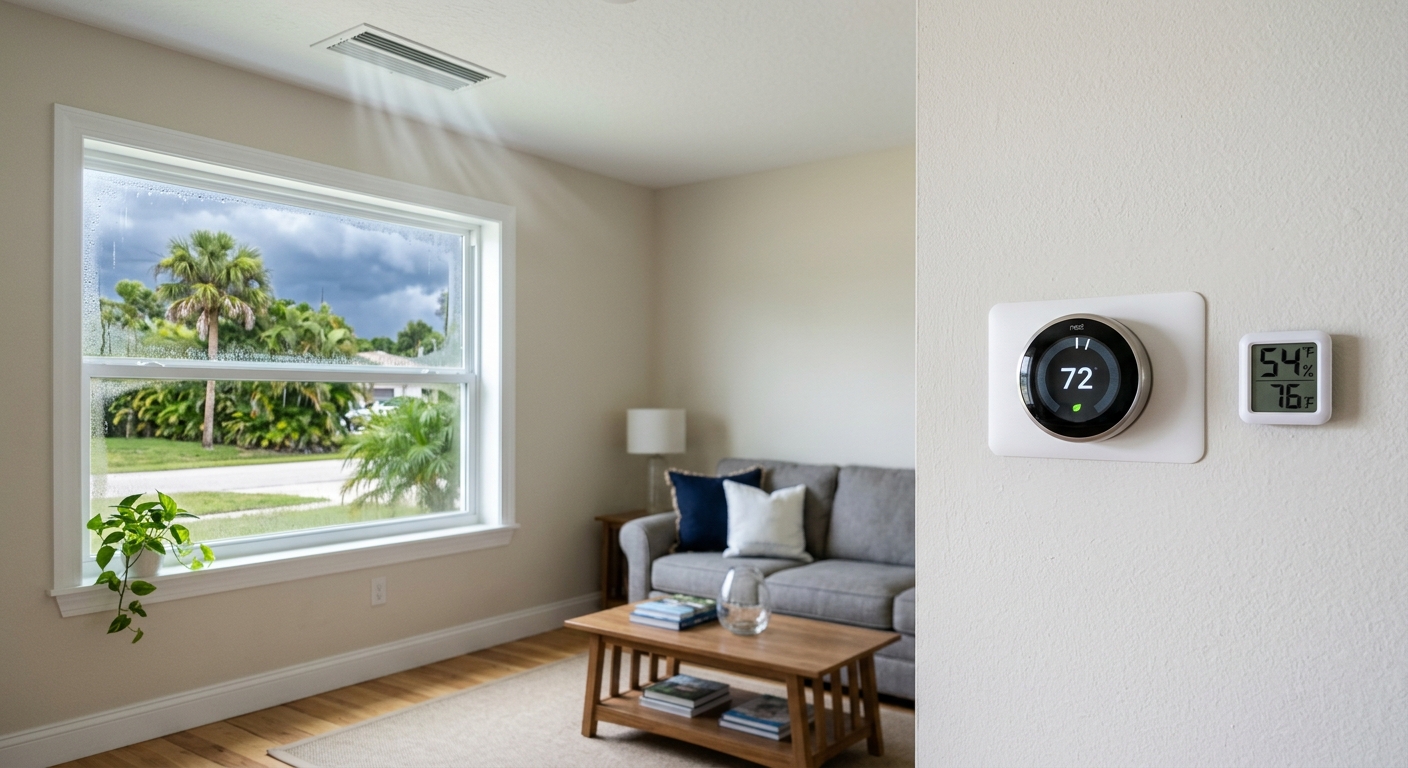
Condensation location matters. Moisture on the outside face of a window can occur when humid outdoor air contacts cool glass and does not necessarily prove that indoor humidity is high. Condensation on indoor surfaces, particularly around vents or cool pipes, deserves closer attention.
Humidity also affects broader Indoor Air Quality. Excess moisture can encourage biological growth and dust mites, while moisture-damaged materials may create odors or release particles into the home.
How should I measure indoor humidity accurately?
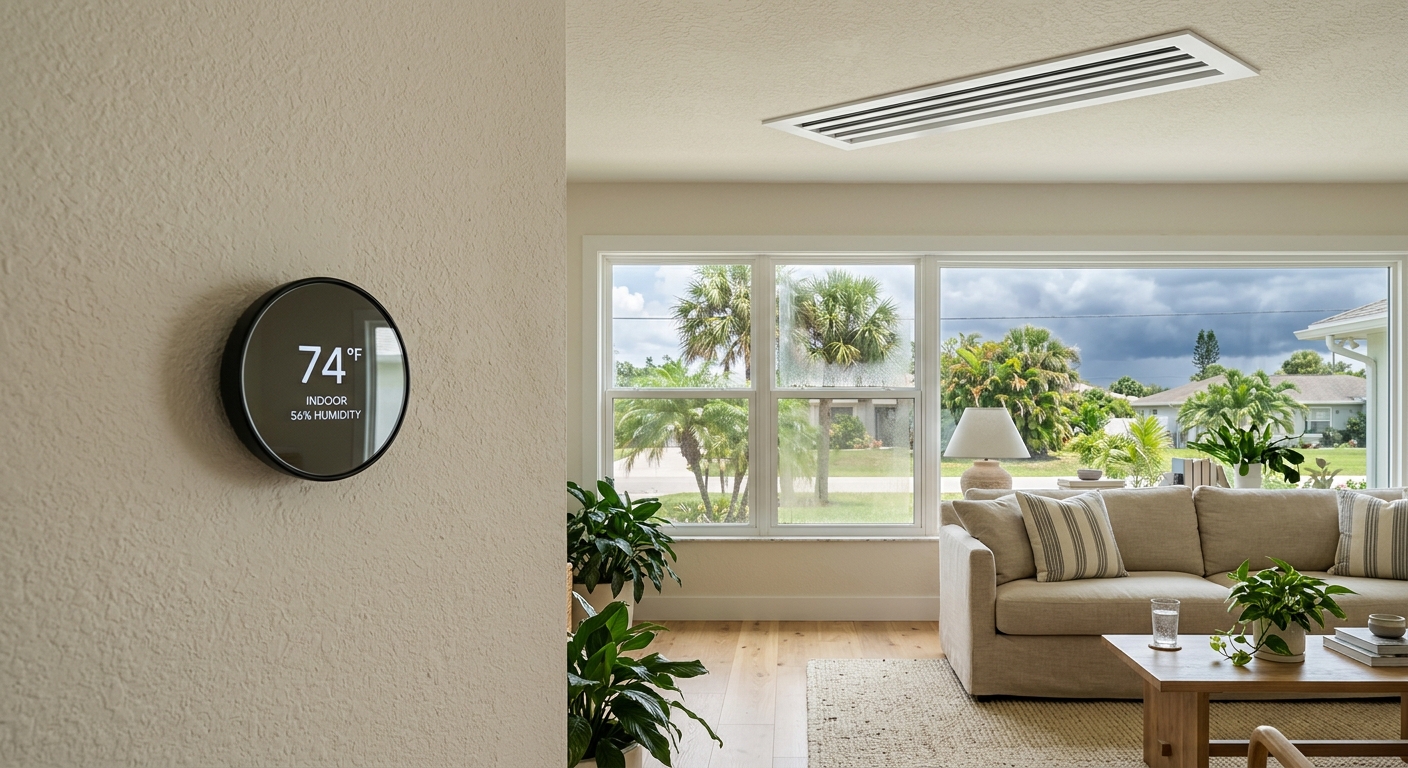
Start with a digital hygrometer or a thermostat that displays relative humidity. Because inexpensive sensors can vary, compare two devices in the same location for a day before relying on a single reading.
Place the sensor in a regularly occupied area away from supply vents, exterior doors, kitchens, bathrooms, direct sunlight, and windows. A reading beside a shower or cold air vent may not represent the rest of the home. If one room has a persistent issue, place a second sensor there and compare it with the central living area.
Track readings at several times of day for at least a week. Note the indoor temperature, outdoor weather, AC operation, and activities such as showering or cooking. This record helps distinguish a temporary spike from an ongoing moisture-control problem.
Does the thermostat's humidity reading tell the whole story?
Not always. A thermostat measures conditions only at its location. Closed bedrooms, additions, rooms with poor air circulation, and closets against exterior walls may have different conditions. If the thermostat reports 52% but a back bedroom consistently measures 65%, the home may have an airflow, duct, infiltration, or localized moisture issue.
How can I lower humidity without overcooling the house?
Begin with operating habits and straightforward maintenance. These steps may improve humidity control without lowering the thermostat several degrees:
- Set the HVAC fan to Auto rather than On. A continuously operating fan can re-evaporate moisture left on the indoor coil after a cooling cycle.
- Use bathroom exhaust fans during showers and for about 15 to 20 minutes afterward. Confirm that fans vent outdoors rather than into the attic.
- Run the kitchen exhaust when boiling water or producing substantial steam, provided the hood vents outdoors.
- Keep exterior doors and windows closed when outdoor air is humid.
- Replace HVAC filters as needed and use a filter compatible with the system's airflow requirements.
- Keep the condensate drain maintained. A blocked or poorly draining line can cause water damage and interrupt AC operation.
- Repair plumbing, roof, window, or exterior-wall leaks promptly. HVAC equipment cannot compensate for an active water intrusion problem.
- Avoid setting the thermostat unusually low solely to reduce humidity. Overcooling increases energy use and can create condensation on cold surfaces.
Homeowners should also pay attention to recent changes. New windows, added insulation, remodeling, a replacement AC system, or changes to ductwork can alter ventilation, airflow, and moisture behavior. A house that becomes humid immediately after HVAC replacement may need setup or sizing reviewed rather than a lower thermostat setting.
Do I need a whole-home dehumidifier in Brevard County?
Not every Florida home needs one. A correctly sized and properly operating air conditioner may maintain the desired range during normal occupancy. A whole-home dehumidifier becomes worth considering when indoor humidity remains above 55% to 60%, especially during mild rainy weather when the AC does not run long enough to remove moisture.
It may also help homes occupied only part of the year, tightly constructed homes with controlled ventilation, properties with known moisture loads, or households that want better humidity control without overcooling. The equipment must be selected, ducted, drained, and controlled correctly; simply installing the largest model is not the best approach.
For a more detailed comparison of symptoms, costs, and system considerations, read Do I Need a Whole-Home Dehumidifier in Florida?.
When should I call an HVAC professional about high humidity?
Schedule an HVAC inspection if humidity remains above 60% for extended periods despite normal cooling operation, or if comfort has changed noticeably. Call sooner if you see water around the air handler, find wet insulation, notice sweating ducts, smell persistent mustiness, or suspect microbial growth.
A professional can evaluate more than the thermostat reading. Useful checks may include system sizing and runtime, refrigerant performance, evaporator coil condition, blower speed, filter restriction, condensate drainage, duct leakage, return-air pathways, thermostat placement, and equipment controls. Depending on the evidence, the solution could be maintenance, an airflow correction, duct repair, source-moisture repair, control changes, or dedicated dehumidification.
If visible growth covers a significant area, repeatedly returns, or follows flooding or contaminated water, HVAC service may be only one part of the response. A qualified moisture-remediation or building professional may also be needed to identify the source and determine appropriate cleanup.
Get help controlling humidity in your Brevard County home
If your home feels sticky, smells musty, or stays above 60% humidity, Aquila Air & Heating can inspect the HVAC system and recommend practical next steps. The goal is to identify why moisture is accumulating rather than automatically selling larger equipment or lowering the thermostat.
Contact Aquila Air & Heating for humidity-control and comfort service across Brevard County. Homeowners considering new qualifying equipment can also review Aquila's Lifetime Warranty information and ask the team for current terms, eligibility requirements, and coverage details.