Duct Leaks and Energy Loss in Florida Homes
Discover how leaking ductwork affects cooling costs, comfort, humidity, and HVAC performance in Brevard County homes—and what to do about it.
Duct leaks waste cooled air, allow hot or humid air into the HVAC system, and make a Florida air conditioner work longer to maintain comfort. In Brevard County, where cooling systems run through much of the year and ducts are often located in hot attics, even modest leakage can contribute to higher energy use, uneven temperatures, excess humidity, and premature equipment wear.
How are duct leaks and energy loss connected?
Your air conditioner uses energy to cool and dehumidify indoor air before the blower sends it through the supply ducts. If a supply duct leaks in an attic, garage, crawlspace, or other unconditioned area, some of that treated air never reaches the intended room. The system may then run longer to satisfy the thermostat.
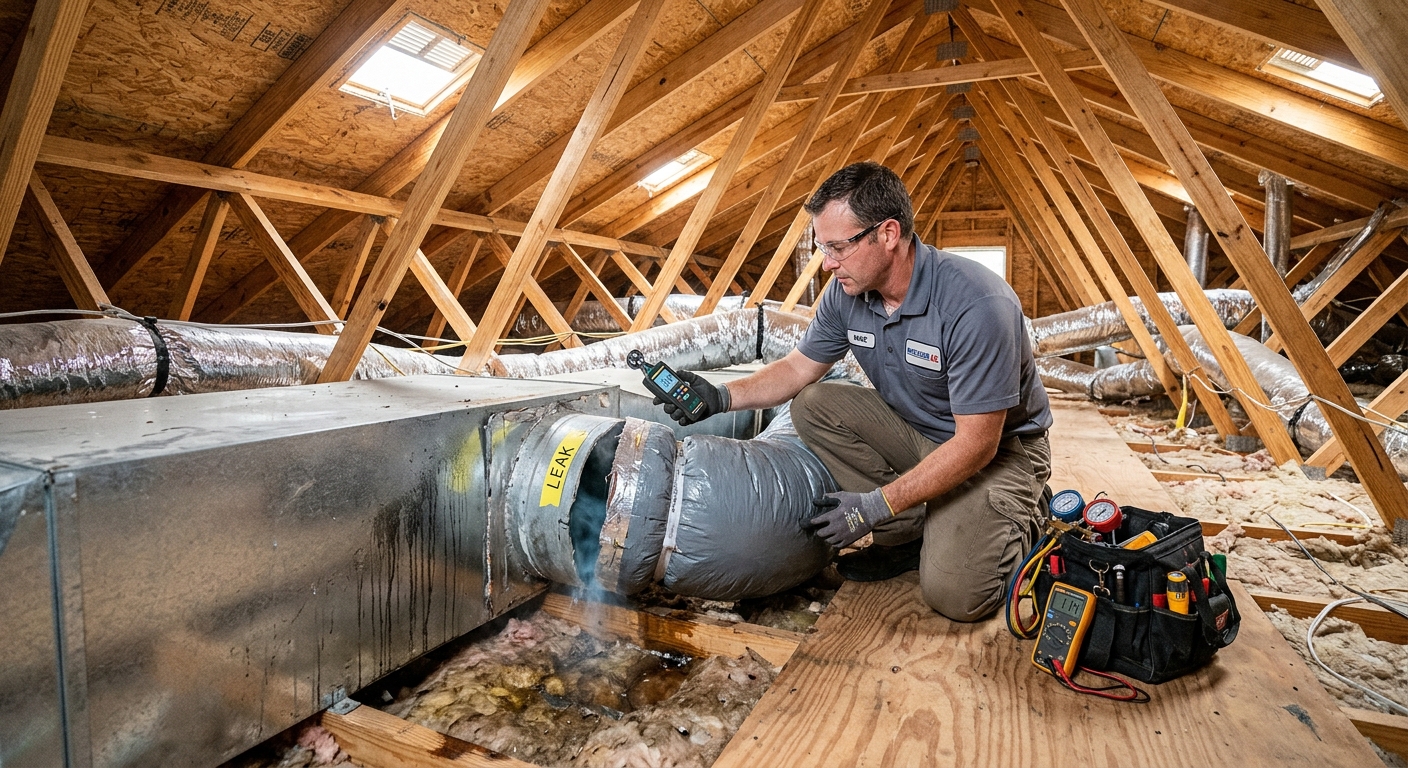
Return-side leaks create a different problem. Instead of losing cooled air, a leaking return can pull hot, dusty, humid air from an attic or wall cavity into the HVAC system. That additional heat and moisture must be removed before the air reaches your living space.
The location of a leak matters. Leakage between ducts and an unconditioned attic generally has a greater energy impact than leakage entirely within the conditioned envelope. Large disconnections, damaged flex ducts, and poorly sealed plenums can be especially disruptive.
Supply leakage can also contribute to negative pressure inside the house, drawing outdoor air through gaps around doors, windows, plumbing penetrations, and recessed fixtures. In a humid coastal climate, that uncontrolled air infiltration can add to the system's moisture load.
Why are Florida homes especially vulnerable to leaking ducts?
Brevard County combines long cooling seasons, high outdoor dew points, intense attic temperatures, afternoon storms, and salt-laden coastal air. Ducts installed in vented attics operate across a large temperature difference: cold supply air travels through ductwork surrounded by extremely hot, humid attic air.
Local duct systems can develop problems for several reasons:
- Flexible duct collars may loosen or separate over time.
- Mastic or approved tape at joints can deteriorate after years of heat exposure.
- Insulation and vapor barriers can be damaged during roofing, electrical, pest-control, or renovation work.
- Rodents or other pests may tear flexible duct material.
- Older additions may have improvised or poorly sized duct runs.
- Condensate or roof leaks can wet duct insulation and surrounding materials.
- Ducts may sag, kink, or become compressed, restricting airflow even when they do not leak.
Homes near the Indian River Lagoon or Atlantic coast are not automatically leakier, but persistent humidity makes leakage and damaged duct insulation more consequential. Moisture problems should be investigated promptly rather than treated as a normal part of living in Florida.
What are the warning signs of duct leakage?
No single symptom proves that a duct is leaking. Refrigerant issues, dirty filters, insulation deficiencies, equipment sizing, thermostat problems, and solar heat gain can produce similar complaints. Several symptoms appearing together, however, justify a closer inspection.
Are some rooms harder to cool than others?
A bedroom, office, or addition that remains warm may have a leaking, disconnected, crushed, or undersized branch duct. Weak airflow from one register is particularly suspicious when airflow elsewhere is normal. Closed dampers, blocked registers, or an unsuitable duct design can cause the same symptom, so diagnosis should go beyond simply feeling for air at the vent.
Has the electric bill increased without an obvious reason?
A longer cooling runtime can raise energy use, but bills also change with weather, thermostat settings, occupancy, utility rates, pool equipment, and appliance use. Compare similar months and review daily usage when possible. If energy consumption rises while comfort declines, the HVAC system and ductwork should both be evaluated.
Do you notice dust, musty odors, or humidity?
A return leak may pull insulation particles, attic dust, or odors into the airstream. Supply leakage and resulting pressure imbalances may increase humid outdoor-air infiltration. Musty smells or visible moisture can also indicate a condensate, roof, plumbing, or building-envelope problem, so do not assume the ducts are the only cause.
Does the air conditioner run for long periods?
Long cycles are common during very hot Brevard County afternoons, especially near a home's design conditions. Persistent operation during milder weather, difficulty reaching the thermostat setting, or a sudden change in runtime deserves attention. Leaking ducts are one possible cause among several.
Can I check for duct leaks myself?
You can perform a basic visual check, but homeowner inspections should be limited to safe, accessible areas. With the system running, look at visible duct connections near the indoor air handler, return grille, and accessible supply boots. Watch for separated joints, torn outer jackets, loose insulation, dark dust streaks around seams, or air movement near connections.
Also check whether registers are open and unobstructed, and replace a dirty filter with the size and type recommended for the system. A filter that is difficult to pull from its slot while the blower runs can indicate pressure at the return, but it does not diagnose duct leakage.
Do not enter a dangerously hot attic, step between ceiling joists, disturb suspected asbestos-containing materials, or reach around electrical equipment. Brevard attics can become hazardous quickly, and flexible ducts are easily crushed by accidental contact.
Holding tissue or using smoke near an accessible seam may reveal obvious air movement, but it cannot measure total leakage. Never use an open flame. Also avoid applying ordinary cloth-backed duct tape; despite its name, it often fails under attic heat and is not a durable HVAC duct sealant.
How does an HVAC professional find hidden duct leaks?
A professional should begin by listening to your comfort concerns and examining the complete air-distribution system. Depending on the home and symptoms, the evaluation may include:
- A visual inspection of accessible ducts, plenums, boots, insulation, and air-handler connections.
- Airflow or temperature measurements at selected supply registers.
- Static-pressure testing to identify excessive resistance within the system.
- A calibrated duct-leakage test, during which registers are temporarily sealed and a test fan measures leakage at a specified pressure.
- Pressure-pan or blower-door-assisted testing to help locate leakage paths to attics or other areas outside the conditioned space.
- Inspection for biological growth, wet insulation, damaged vapor barriers, or condensate problems when moisture is present.
Static pressure and duct leakage are related but different measurements. A system can have restrictive ducts without major leakage, or substantial leakage without unusually high static pressure. Good diagnostics distinguish between these problems before repairs are recommended.
What is the right way to repair leaking ductwork?
The correct repair depends on the duct material and the condition of the system. Accessible metal seams and small gaps are commonly sealed with HVAC mastic or an appropriate UL 181-listed product. Flexible duct connections generally need to be mechanically secured at the inner liner, sealed correctly, and then reinsulated with the outer vapor barrier restored.
Common professional repairs include:
- Reconnecting detached supply or return runs.
- Sealing joints around plenums, takeoffs, air handlers, and register boots.
- Repairing or replacing torn flexible ducts.
- Supporting sagging runs at suitable intervals and removing sharp bends.
- Replacing wet, contaminated, brittle, or badly deteriorated insulation.
- Correcting return pathways or duct sizing when leakage is not the main issue.
Sealing a visibly disconnected joint can provide a meaningful improvement, but sealing alone cannot correct every comfort problem. A duct that is too small, routed poorly, or extensively deteriorated may need replacement or redesign. Closing registers to force more air into another room is usually not a good substitute because it can increase system pressure and reduce airflow.
Will duct sealing lower my cooling bill?
It can, particularly when significant leakage occurs outside the conditioned space. The actual change depends on the size and location of the leaks, duct insulation, system efficiency, thermostat habits, house construction, and weather. No contractor can responsibly promise a specific savings percentage without evaluating the home.
Benefits may also appear as more consistent room temperatures, shorter runtime during moderate conditions, less dust intrusion, or improved humidity control. These improvements should be verified after repair through airflow measurements, leakage testing, or comparison of energy use under similar weather conditions.
How can Brevard County homeowners prevent future duct problems?
Include accessible ductwork in routine HVAC inspections rather than waiting for a complete disconnection. During professional AC Maintenance, ask the technician to note damaged insulation, loose air-handler connections, unusual static pressure, drain problems, and visible duct defects. A standard tune-up is not necessarily the same as a full duct-leakage test, so request specific testing if you have ongoing comfort or energy concerns.
After roof replacement, attic electrical work, pest service, or home renovations, inspect the affected area for crushed or displaced ducts. Keep attic access panels weather-stripped where appropriate, maintain clean filters, and avoid storing items on top of flexible ducts. If condensation appears on ducts or supply grilles, address it quickly; the cause may involve leakage, insulation failure, low airflow, indoor humidity, or a combination of factors.
When should I call an HVAC professional?
Schedule professional service when you find a disconnected duct, smell persistent musty odors, see wet insulation, notice sweating around vents, or experience a sudden loss of airflow. You should also call when the air conditioner runs continuously but cannot maintain temperature, multiple rooms are uncomfortable, or electric use rises without a clear explanation.
Turn the system off and seek prompt help if water is approaching electrical components, duct damage exposes wiring, or you suspect smoke or combustion gases are entering the return system. Homes with fuel-burning appliances may require additional pressure and safety evaluation because duct-related pressure imbalances can affect combustion venting.
Who can help with duct concerns in Brevard County?
Aquila Air & Heating can inspect your HVAC system, identify likely duct defects, and explain whether targeted sealing, duct replacement, airflow correction, or another repair makes sense. Contact our family-run team for practical guidance based on your home's layout and actual test findings rather than assumptions.
If an evaluation shows that HVAC equipment replacement is also appropriate, homeowners can review Aquila's Lifetime Warranty information, including the applicable terms and eligibility details. Aquila Air & Heating is Florida's First HVAC Company Offering a Lifetime Warranty, while duct repair recommendations remain based on the condition and performance of each individual system.