How Humidity Drives Up Your Energy Bills
High indoor humidity can make your home feel warmer, increase AC runtime, and encourage lower thermostat settings. Learn how to control it in Brevard County.
High indoor humidity can increase energy bills by making your home feel warmer and forcing your air conditioner to remove both heat and moisture. In Brevard County, humid outdoor air, duct leakage, short AC cycles, and thermostat habits can combine to keep cooling costs high even when the equipment appears to be working.
Most homeowners can reduce this burden by controlling air leaks, using exhaust fans correctly, maintaining the AC system, and keeping indoor relative humidity near 45% to 55% when practical. Persistent readings above 60% usually warrant closer investigation.
Why does humidity make my air conditioner use more electricity?
An air conditioner has two related jobs: lowering the air temperature and removing water vapor. HVAC professionals refer to these as sensible cooling and latent moisture removal. When warm indoor air passes over the cold evaporator coil, moisture condenses on the coil and drains away through the condensate system.
The more moisture that enters or develops inside your home, the more work the system must do. Brevard County homes face a substantial latent load because outdoor air is frequently warm and humid. Sea breezes, summer thunderstorms, long rainy periods, and routine door opening can all introduce moisture.
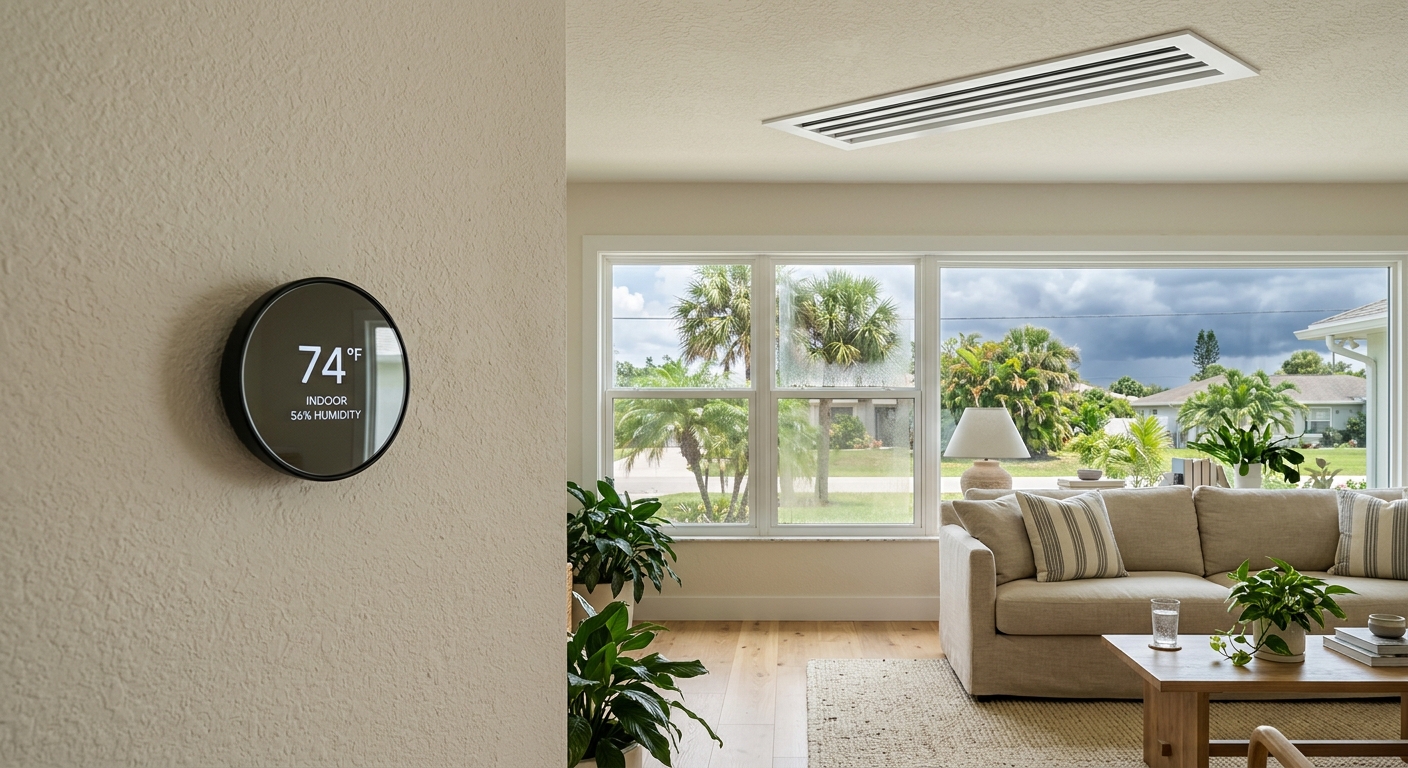
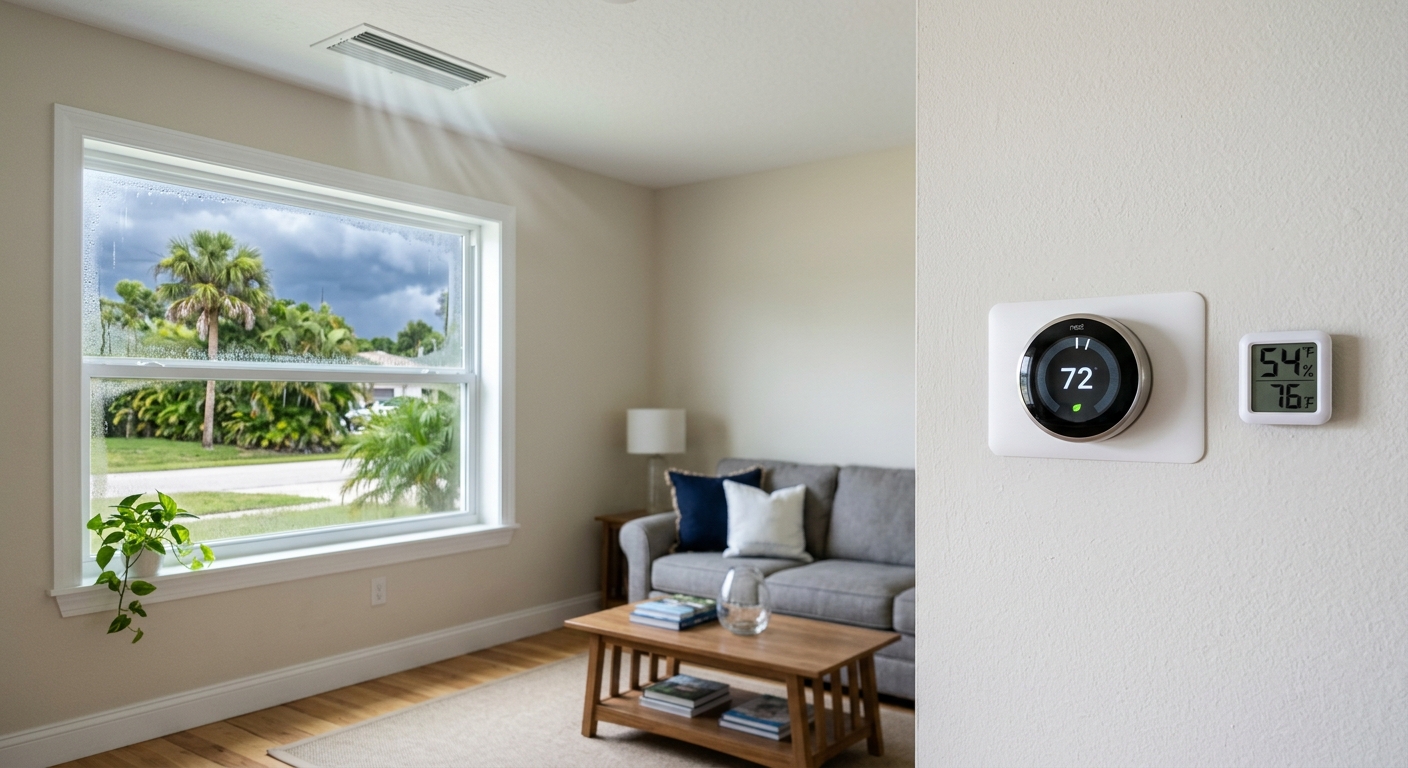
Humidity also changes how the air feels. Perspiration cannot evaporate as efficiently when relative humidity is high, so a room at 76°F may feel uncomfortable even though the thermostat has reached its setting. Homeowners often respond by lowering the thermostat several degrees. That increases runtime and energy consumption without addressing the source of the humidity.
What indoor humidity level should Brevard County homeowners target?
A practical target for many air-conditioned Florida homes is approximately 45% to 55% relative humidity. Conditions and comfort preferences vary, but indoor humidity should generally remain below 60% for extended periods. Sustained readings above that level can contribute to musty odors, condensation, dust mite activity, and microbial growth on damp materials.
A small digital hygrometer can provide a useful first measurement. Place it in a central living area away from supply vents, exterior doors, kitchens, and bathrooms. Check it at different times over several days because indoor humidity can change with weather, occupancy, cooking, showering, and AC runtime.
Do not focus on a single brief spike after a shower or while an exterior door is open. A repeated pattern is more meaningful. If your home remains above 60% during normal cooling operation, review Can Your AC Remove Too Little Humidity? for common system-related explanations.
How does high humidity show up on an electric bill?
Humidity does not appear as a separate line on your utility statement. Instead, its effects may show up as longer cooling cycles, more frequent thermostat adjustments, or unusually high electricity use compared with similar weather in a previous year.
Possible warning signs include:
- The thermostat reaches its set temperature, but rooms still feel sticky or clammy.
- You regularly lower the setting to become comfortable.
- The AC runs for long periods during humid weather without controlling indoor moisture.
- Supply vents or nearby surfaces develop condensation.
- Closets, bedrooms, or other low-airflow areas smell musty.
- Indoor humidity stays above 60% even while the system is cooling.
Compare energy use carefully. A higher bill can also result from hotter weather, utility rate changes, additional occupants, pool equipment, water heaters, or other appliances. Reviewing daily kilowatt-hour use is more informative than comparing bill totals alone.
What HVAC problems can cause high humidity and high energy bills?
Can an oversized air conditioner leave the house humid?
Yes. An oversized AC can cool the air quickly and shut off before the evaporator coil has enough operating time to remove adequate moisture. This short cycling may produce cool but clammy rooms. Correct equipment sizing should be based on a detailed cooling-load calculation rather than the square footage of the home alone.
Can dirty equipment reduce moisture removal?
A clogged filter, dirty evaporator coil, blocked return, or incorrect blower setting can affect airflow and system performance. Too little airflow can create icing and equipment problems, while excessive airflow across the coil may reduce moisture removal under some conditions. Because airflow must match the equipment, blower adjustments should be made by a qualified HVAC technician.
Do leaking ducts pull humid air into the system?
They can. Many Brevard County duct systems run through hot attics or other unconditioned spaces. Leaks on the return side may draw humid attic air into the system, while supply leaks can waste cooled, dehumidified air before it reaches the rooms. Both problems increase the cooling load and can raise operating costs.
Can a clogged condensate drain affect humidity control?
A partially blocked drain can interfere with normal condensate removal and may eventually trigger a safety switch or cause water damage. Algae growth is common in Florida drain lines, so condensate components should be inspected during routine maintenance. Water around the indoor unit, repeated drain backups, or a system that shuts down unexpectedly calls for prompt attention.
What can I do now to lower humidity-related cooling costs?
Start with changes that reduce moisture entry and help the existing system operate as designed:
- Set the thermostat fan to AUTO rather than ON. A continuously operating fan can re-evaporate moisture left on the coil after a cooling cycle.
- Replace or clean the air filter according to the manufacturer’s instructions. Use a filter that your system can handle without excessive airflow resistance.
- Run bathroom exhaust fans during showers and for about 15 to 20 minutes afterward. Confirm that they vent outdoors rather than into the attic.
- Use the kitchen exhaust hood when boiling water or producing steam, provided the hood vents outside.
- Keep exterior doors and windows closed while the AC is operating. Check worn weatherstripping around frequently used doors.
- Avoid dramatic thermostat changes. A steady, reasonable setting generally provides more consistent moisture removal than repeatedly turning the temperature up and down.
- Keep supply registers and return grilles unobstructed by furniture, curtains, or rugs.
- Check indoor humidity with a reliable hygrometer instead of judging by temperature alone.
Portable dehumidifiers can help a specific room, but they consume electricity and release some heat into the space. Emptying buckets also becomes inconvenient in a persistently humid home. If several rooms are affected, it is usually better to identify the source before relying on multiple portable units.
Will a whole-home dehumidifier lower my energy bill?
A whole-home dehumidifier can improve comfort and moisture control when the AC alone cannot meet the home’s latent load, especially during Florida’s mild but humid shoulder seasons. It still uses electricity, so it should not be presented as an automatic bill-reduction device.
Potential savings depend on how the household responds. If better humidity control allows you to feel comfortable at a higher thermostat setting, total cooling use may decrease. However, installation quality, controls, duct design, building leakage, and equipment sizing all influence the result. A professional assessment can determine whether dehumidification, duct sealing, ventilation changes, or AC corrections are the appropriate solution.
Humidity is only one part of healthy indoor conditions. Filtration, ventilation, source control, and equipment cleanliness also matter. Aquila’s Indoor Air Quality services can help Brevard County homeowners evaluate the home as a complete system rather than treating every comfort complaint as a thermostat problem.
When should I call an HVAC professional about indoor humidity?
Schedule an inspection when humidity remains above 60% for several days during normal AC operation, rooms feel clammy despite adequate cooling, or energy use rises without an obvious change in weather or household activity. You should also call if the system starts and stops frequently, struggles to reach the thermostat setting, develops ice, leaks water, or produces musty odors.
Visible mold growth, wet drywall, or recurring condensation may involve a plumbing, roofing, drainage, or building-envelope problem in addition to HVAC performance. Address active water intrusion first and use qualified remediation help when the affected area or material requires it. An air conditioner cannot compensate for an unresolved leak.
A professional humidity evaluation may include temperature and relative-humidity readings, filter and coil inspection, condensate testing, airflow measurement, thermostat review, refrigerant checks when indicated, and examination of accessible ductwork. Ask for measurements and a clear diagnosis before approving major equipment changes.
How can Aquila Air & Heating help?
Aquila Air & Heating serves homeowners across Brevard County and the Space Coast. Our team can evaluate whether high humidity energy bills are related to maintenance, airflow, duct leakage, equipment sizing, controls, or the amount of outdoor moisture entering the home.
If repairs or replacement options are recommended, ask what each option is expected to change and how performance will be verified. Aquila is Florida's First HVAC Company Offering a Lifetime Warranty. Coverage, eligibility, terms, and available equipment are explained on our Lifetime Warranty page.
If your home feels sticky, your AC runs excessively, or indoor humidity stays above 60%, contact Aquila Air & Heating to schedule an evaluation. Measuring the problem now can help you avoid guessing at thermostat settings and paying for energy that does not improve comfort.