
Are Mini-Splits Good for Florida Garages and Additions?
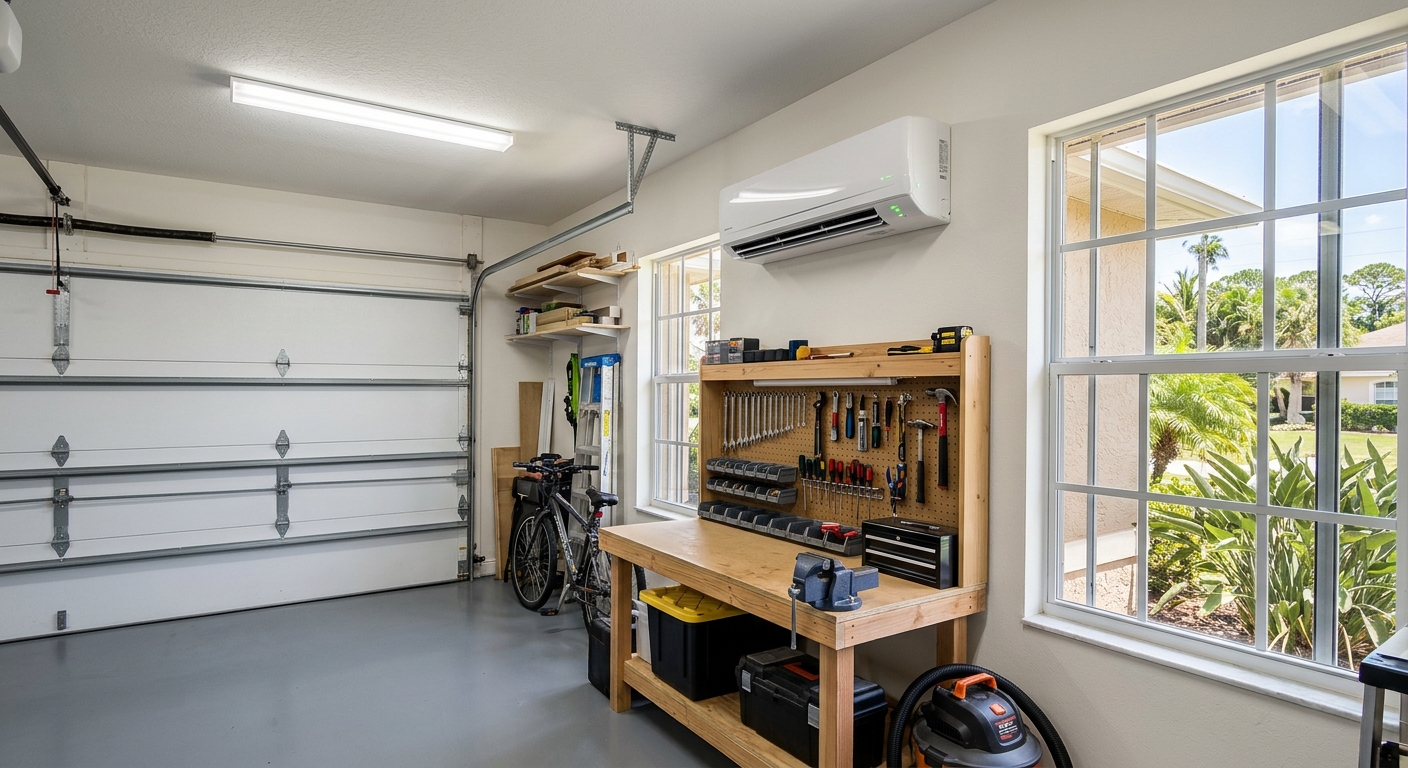
Mini-splits can cool Florida garages and additions efficiently, but insulation, humidity, equipment sizing and installation all affect performance.
Yes, mini-splits can be an excellent choice for Florida garages and home additions because they provide independent temperature control without extending existing ductwork. In Brevard County, however, good results depend on proper sizing, insulation, humidity management and protection of the outdoor equipment from coastal conditions. A mini-split cannot compensate for an unsealed garage door, excessive air leakage or an incorrectly calculated cooling load.
Why do mini-splits work well in Florida garages and additions?
A ductless mini-split uses an indoor air handler connected to an outdoor unit by refrigerant lines, electrical wiring and a condensate drain. Most systems installed in homes are heat pumps, which means they can provide cooling during Brevard County's long warm season and heating during occasional winter cold spells.
Unlike a central air conditioning system, a mini-split does not need a network of supply and return ducts. That makes it practical for a space that was not included in the home's original HVAC design, such as a garage workshop, enclosed porch, detached studio or newly built room addition.
Mini-splits also create a separate comfort zone. You can condition the space when it is occupied without changing the thermostat for the entire house. Inverter-driven equipment can adjust its output as conditions change rather than operating only at full capacity, provided the system is sized and installed correctly.
Homeowners considering a ductless system should begin with a professional assessment rather than choosing equipment based only on square footage. Aquila's professional HVAC installation services in Brevard County include evaluating the space, comfort goals and installation requirements before recommending equipment.
Is a mini-split a good way to cool a Florida garage?
A mini-split can make a garage much more comfortable for exercise, hobbies, laundry, storage or workshop use. Garages are challenging cooling environments, though, and their actual heat gain may be much higher than that of a similarly sized bedroom.
Common sources of garage heat and humidity include:
- Large garage doors exposed to direct morning or afternoon sun
- Uninsulated doors, ceilings or exterior walls
- Air leakage around door panels and weatherstripping
- Heat retained by concrete floors, vehicles and the roof
- Frequent opening of the overhead door
- Outdoor humidity entering whenever the space is open
Insulating the garage door and ceiling, sealing safe and appropriate air leaks, and adding window shading may reduce the cooling load substantially. These improvements can help the mini-split maintain a steadier temperature and remove moisture more effectively.
Expect the temperature and humidity to rise when the overhead door is left open. A mini-split is designed to condition an enclosed space, not continuously cool incoming outdoor air. After the door closes, recovery time will depend on the outdoor weather, insulation, system capacity and how long the garage was open.
Can a mini-split make a garage safe for sleeping?
No HVAC system by itself turns a garage into legal or safe living space. A conversion may require permits, compliant insulation, emergency egress, fire separation, electrical work and other building upgrades. Attached garages also need separation from the living area because vehicles can produce carbon monoxide and stored products may release fumes.
A ductless unit does not bring in fresh air and should never be treated as ventilation for vehicle exhaust, gasoline vapors, solvents or workshop contaminants. Do not run a vehicle in a closed garage, even when the mini-split is operating. Spaces with combustible vapors, heavy dust or unusual industrial activities require a specialized safety evaluation because standard residential equipment is not designed for every hazardous environment.
Are mini-splits suitable for room additions?
Mini-splits are often a strong option for additions because extending the home's existing ductwork is not always practical. The current central system may lack enough capacity for the extra room, and a long or poorly routed duct extension can create airflow and comfort problems in both the new space and the original house.
A dedicated mini-split allows the addition to have its own thermostat and schedule. This can work well for a sunroom, home office, guest suite, in-law space or enclosed patio that experiences different sun exposure than the rest of the home.
Before selecting a ductless system, compare it with other viable approaches. If the addition is part of a larger renovation or the existing central unit is due for replacement, integrating the new space into a properly redesigned system may make more sense. Aquila's air conditioning installation options can help homeowners compare ductless and central solutions based on the complete house rather than one room in isolation.
What if the addition contains several rooms?
A single wall-mounted air handler works best when air can circulate freely throughout one open area. It may not provide even comfort through closed bedroom or bathroom doors. A multi-zone system, compact ducted unit or separate indoor heads may be more appropriate for a divided floor plan.
Multi-zone systems require careful design. Each room has its own load, and the combined indoor units must be compatible with the outdoor unit. Selecting equipment solely by adding the nameplate capacities of several indoor heads can lead to poor humidity control or inefficient operation.
How should a mini-split be sized for Brevard County?
Rules based only on floor area are not reliable enough for garages and additions. A professional load calculation should consider the size and orientation of windows, ceiling height, insulation, air leakage, roof construction, occupancy, lighting, appliances and solar exposure. A west-facing garage door in Palm Bay may create a very different load from a shaded addition of the same size in Titusville.
Bigger is not automatically better. An oversized system may lower the temperature quickly and then reduce output or cycle without removing enough moisture. An undersized unit may run continuously on hot afternoons while failing to reach the desired temperature. Correct sizing helps balance temperature control, moisture removal, operating sound and equipment longevity.
If winter comfort matters, confirm that the selected model is a heat pump and review its heating performance. Brevard County has a mild climate, but cool mornings still occur. Homeowners comparing broader heating options can review Aquila's heat pump installation services.
Will a mini-split control garage humidity?
A mini-split removes moisture while cooling, but it is not a substitute for fixing water intrusion or major air leakage. Brevard County's humid air can enter through worn garage-door seals, open windows, wall penetrations and gaps around an addition. Roof leaks, plumbing leaks and moisture moving through damaged building materials also need to be corrected directly.
Consistent operation at a reasonable thermostat setting generally supports better moisture control than switching the system off for long periods and then demanding a rapid temperature drop. Some units have a dry or dehumidification mode, but its operation varies by model. A technician can explain what a particular system does and whether a separate dehumidifier should be considered.
The condensate drain must have the correct slope, discharge location and protection against blockage. Algae and debris can obstruct drains in Florida's warm climate, potentially causing water damage or triggering a safety switch.
What installation details matter near Florida's coast?
Mini-split installation involves more than mounting an indoor unit. The refrigerant circuit must be correctly assembled, evacuated, tested and charged according to manufacturer requirements. Electrical service, disconnects, overcurrent protection, condensate disposal and wall penetrations also need to comply with applicable codes and instructions.
Important Brevard County considerations include:
- Mounting the outdoor unit on a stable, appropriately elevated base or approved wall bracket
- Anchoring equipment for local wind conditions
- Keeping the unit clear of roof runoff, irrigation spray and restricted airflow
- Sealing wall penetrations against rain, pests and humid air
- Locating the indoor head where it can distribute air across the occupied area
- Planning access for filter cleaning, drain service and future repairs
Salt-laden coastal air can accelerate corrosion, especially on properties close to the ocean or Indian River Lagoon. Equipment placement and manufacturer-approved maintenance can help reduce exposure. Do not coat coils or electrical components with unapproved products, because doing so may damage the equipment or conflict with manufacturer requirements.
Permit requirements can depend on the project scope and whether the property falls under Brevard County or a municipal jurisdiction. A licensed HVAC contractor can identify the applicable mechanical, electrical and building requirements. If a garage is being converted into conditioned living space, consult the relevant building department before construction begins.
When is a mini-split not the best choice?
A mini-split may not be the right solution when the space has unresolved roof or wall leaks, severe air leakage, hazardous fumes, or a layout that prevents air from reaching occupied rooms. It may also be unnecessary when the existing central system and ductwork can serve a small addition after a qualified design review.
Consider another approach or additional building improvements if:
- The garage door will remain open for much of the day
- The space is used for activities that generate heavy dust, smoke or chemical vapors
- Several closed rooms need independent airflow
- The electrical panel cannot support the new equipment without upgrades
- The structure lacks the insulation needed for dependable comfort
- The project is actually a full garage conversion requiring broader code work
When should you call an HVAC professional?
Call a licensed HVAC contractor before purchasing equipment if you are unsure about capacity, electrical requirements, condensate routing or outdoor-unit placement. Professional help is also important when an existing mini-split leaks water, freezes, produces unusual odors, trips a breaker, stops maintaining humidity or makes new mechanical noises.
A site visit should include questions about how the room will be used, how often garage doors will open, whether walls and ceilings are insulated, and which surfaces receive strong sun. The contractor should also discuss maintenance access and realistic performance rather than promising that equipment alone will solve building-envelope problems.
Get a mini-split recommendation for your Brevard County space
Aquila Air & Heating can evaluate garages and additions throughout Brevard County and recommend whether a ductless mini-split, central system or building improvement is the better next step. The goal is to match the equipment to the actual room, Florida humidity and your day-to-day use.
Contact Aquila Air & Heating to schedule an assessment and ask about available installation options. Aquila is Florida's First HVAC Company Offering a Lifetime Warranty; review the Lifetime Warranty details for eligibility, terms and covered installations.