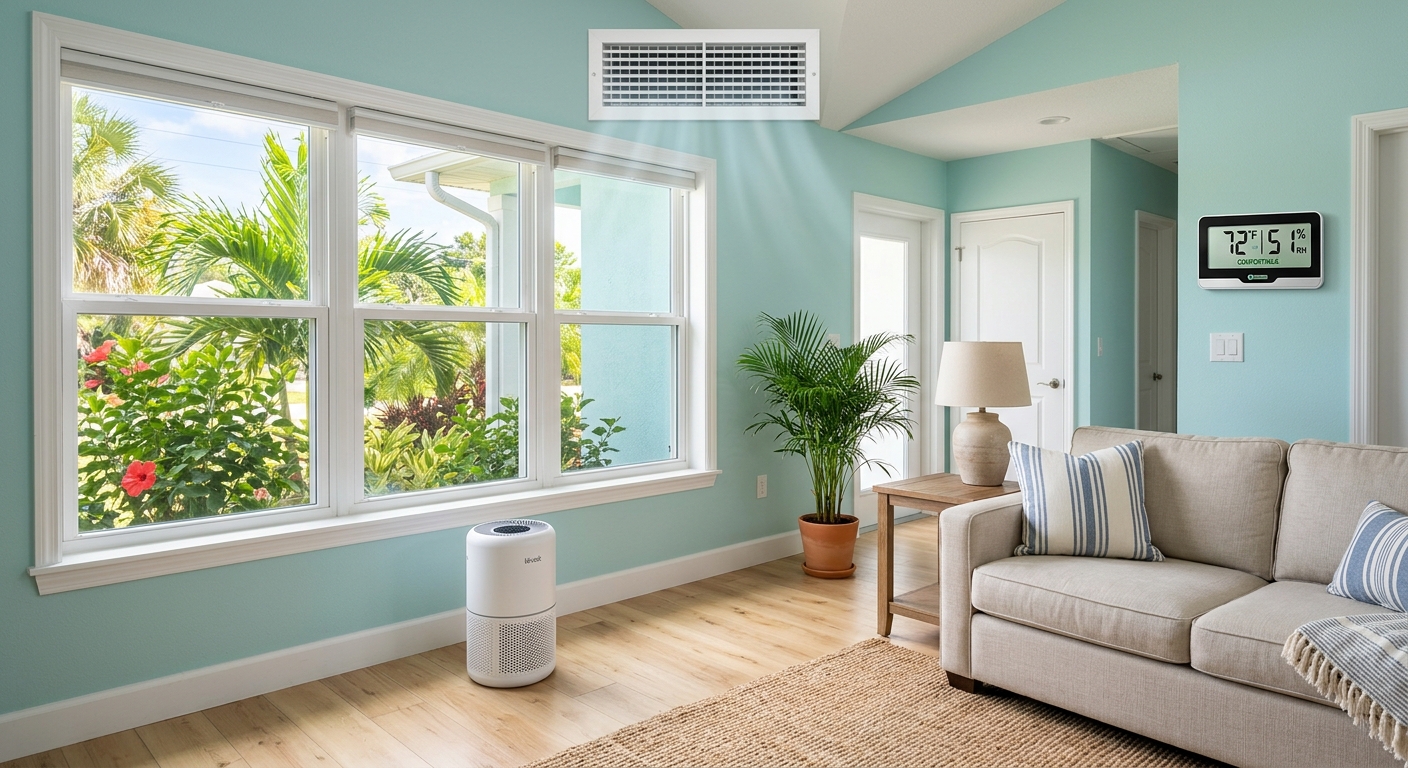
Do UV Air Purifiers Help With Florida Mold and Allergens?
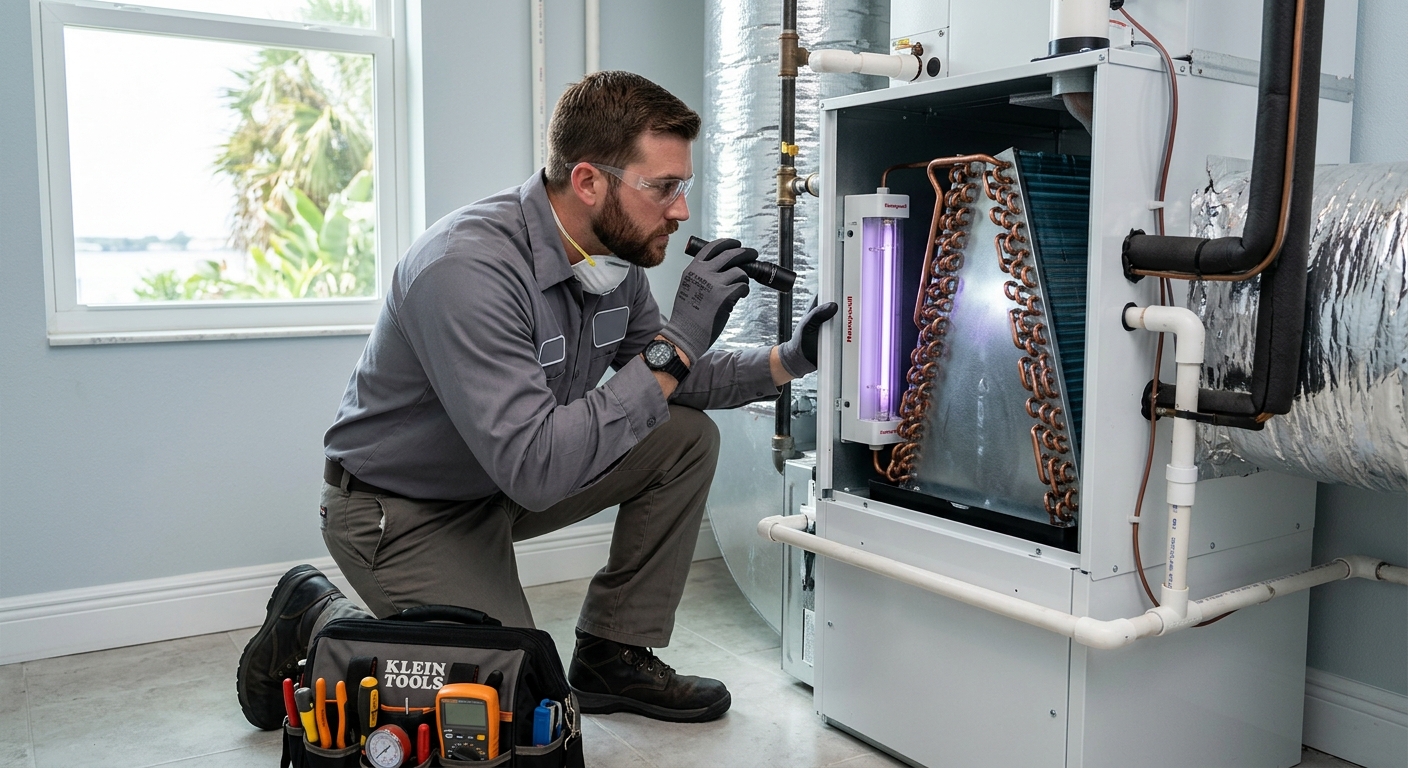
UV-C air purifiers can inhibit microbial growth inside an HVAC system, but controlling Florida mold and allergens also requires filtration and moisture management.
Yes—but UV air purifiers are most effective as one part of a broader indoor air quality plan. A properly installed HVAC UV-C light can inhibit microbial growth on coils and other illuminated surfaces, while filtration, humidity control and moisture repairs are still needed to address mold spores and common Florida allergens.
For Brevard County homeowners, the key is understanding what UV technology targets, what it leaves behind and whether moisture or filtration is the bigger issue in the home.
How does a UV air purifier work?
Most HVAC UV air purifiers use ultraviolet germicidal irradiation, commonly called UV-C. The light damages the genetic material of susceptible microorganisms, reducing their ability to reproduce when they receive a sufficient dose.
UV effectiveness depends on light intensity, exposure time, distance from the lamp, placement and cleanliness. Because residential HVAC air moves quickly, microorganisms passing through a duct may receive only brief exposure. For this reason, UV lights are often installed to shine continuously on the evaporator coil and nearby drain pan, where condensation can create conditions favorable to microbial growth.
A professionally designed whole-home air purification system may combine UV-C with filtration or other technologies. The combination matters because UV light and filters perform different jobs.
Can UV light stop mold in a Florida HVAC system?
UV-C can help inhibit mold and other biological growth on HVAC surfaces that remain directly exposed to the light. This can be particularly useful around an indoor evaporator coil, which becomes wet as it removes heat and moisture from the air during cooling.
However, UV light does not remove an existing layer of mold, dirt or biological debris. It also cannot reach growth hidden behind insulation, inside walls or on surfaces blocked from the lamp. A contaminated system may require appropriate cleaning before UV equipment is installed.
Does UV light remove mold spores from the air?
Not in the way a filter removes particles. UV-C may inactivate some spores that receive an adequate dose, but the spores remain physically present unless they are captured by filtration or removed through cleaning. Both viable and nonviable mold particles may still irritate sensitive occupants.
This distinction is important when comparing a UV air purifier, mold and allergens. UV technology addresses susceptible microorganisms; it does not function as a particle collector and does not solve the moisture source that allowed mold to develop.
Will UV fix a musty smell?
Not necessarily. A musty odor may come from a wet evaporator coil, clogged condensate drain, damp duct insulation, plumbing leak, roof intrusion or high indoor humidity. UV may help prevent new growth on an illuminated coil, but an odor will often return unless the underlying moisture and contaminated material are addressed.
Do UV air purifiers reduce pollen, dust and pet allergens?
UV light is not an effective substitute for mechanical filtration. Pollen, pet dander, dust mite debris and most household dust are nonliving particles, so exposing them to UV-C does not remove them from the air.
A correctly sized HVAC filter captures particles as air circulates through the system. Higher-efficiency filters may capture smaller particles, but the filter must be compatible with the equipment and duct system. Installing a highly restrictive filter without checking system airflow can reduce comfort, increase energy use or contribute to coil icing.
Homeowners dealing with seasonal symptoms can review additional indoor air quality steps for Brevard County allergy sufferers, including filtration, source control and routine cleaning. Anyone experiencing persistent or serious symptoms should also consult a qualified healthcare professional.
Why are mold and humidity persistent concerns in Brevard County?
Brevard County’s warm, humid climate creates a long cooling season. Outdoor air can enter through normal ventilation, frequently opened doors, building leaks and leaky return ducts. Storm damage, roof leaks and wind-driven rain can introduce additional moisture.
An air conditioner removes moisture while it runs, but several conditions can interfere with that process:
- An oversized AC may cool the house quickly and shut off before removing enough moisture.
- Air leaks can pull humid attic, garage or outdoor air into the duct system.
- Clogged condensate drains or dirty coils can interfere with normal operation.
- Leaving windows or doors open can introduce significant outdoor humidity.
- Changing the thermostat dramatically throughout the day can result in inconsistent moisture control.
- Water intrusion from roofing, plumbing or storms can overwhelm the HVAC system’s normal dehumidification capacity.
The U.S. Environmental Protection Agency generally recommends keeping indoor relative humidity below 60%, and ideally between 30% and 50% when practical. In coastal Florida, maintaining the lower end of that range may be difficult, but persistent readings above 60% deserve attention.
A whole-home dehumidifier may help when indoor humidity remains elevated even though the cooling system is working correctly. It does not replace leak repairs or mold cleanup, but it can manage moisture independently of an AC cooling cycle.
Is a coil-mounted UV light or in-duct purifier better?
The right configuration depends on the goal. A coil-mounted light is positioned to irradiate the evaporator coil and nearby surfaces continuously. This is often the most predictable residential use because the target remains in a fixed location and can receive prolonged exposure.
An in-duct UV system is intended to treat microorganisms moving through the airstream. Its performance depends heavily on airflow speed, lamp output, duct dimensions, reflectivity and the organism’s resistance to UV exposure. A device should not be assumed to neutralize every microorganism in a single pass.
Some products combine UV-C with a media filter, while others marketed as air purifiers use entirely different technologies. Ask for a clear explanation of what each component does and whether replacement lamps, filters or other routine maintenance will be required.
What should I look for in a residential UV air purifier?
A useful system should be selected for the HVAC equipment and installed where it can safely deliver UV exposure to the intended target. Before purchasing, ask these questions:
- Is the main objective coil treatment, airstream treatment, particle filtration or a combination?
- Where will the lamp be installed, and which surfaces will it actually illuminate?
- Is the product designed to avoid intentional ozone production?
- Will the UV output affect nearby plastic, wiring, filters or drain components?
- How often does the manufacturer require lamp replacement or cleaning?
- Can the system be serviced without exposing a person’s eyes or skin to UV-C?
- Will added filtration create excessive airflow resistance?
A UV lamp may continue glowing after its germicidal output has declined, so appearance alone does not confirm that it is operating at the intended strength. Follow the manufacturer’s replacement schedule and have lamp condition and placement checked during routine HVAC service.
Direct UV-C exposure can injure eyes and skin. The light should remain enclosed within the HVAC cabinet or ductwork, and safety interlocks or service procedures should prevent accidental exposure. Homeowners should not look directly at an operating lamp.
What else should accompany a UV air purifier?
The strongest approach usually combines several methods based on the home’s actual conditions:
- Source control: Repair plumbing, roofing and condensate leaks promptly. Remove water-damaged porous material when it cannot be properly dried or cleaned.
- Humidity management: Use AC settings and, where appropriate, dedicated dehumidification to keep indoor moisture under control.
- Compatible filtration: Choose an effective filter that the blower and duct system can support, then replace it on schedule.
- HVAC maintenance: Keep the evaporator coil, drain pan and condensate line clean and operating correctly.
- Duct evaluation: Investigate damaged ducts, disconnected sections and return leaks that may draw humid or contaminated air from unconditioned areas.
- Housekeeping: Use a sealed HEPA vacuum where appropriate, wash bedding regularly and control tracked-in pollen.
An indoor air quality evaluation can help determine whether UV treatment, better filtration, humidity control or equipment repairs should be prioritized. Buying a device without identifying the source can leave the main problem unresolved.
When should a Brevard County homeowner call a professional?
Schedule an HVAC inspection if you notice recurring growth around supply registers, persistent musty odors, unexplained high humidity, water near the air handler, repeated condensate drain clogs or an evaporator coil that appears dirty. A technician can check equipment sizing, temperature performance, drainage, airflow, duct leakage and potential UV installation locations.
Contact an appropriate water-damage or mold-remediation professional when visible growth is extensive, repeatedly returns after cleaning, involves contaminated water or appears inside walls and other concealed areas. The EPA suggests professional guidance when the affected area is larger than about 10 square feet or when HVAC contamination is suspected. Sensitive occupants should avoid disturbing suspected mold because doing so may release additional particles.
If a UV system is already installed but odor or growth continues, do not assume the lamp has failed. The problem may involve lamp age, poor placement, shadowed surfaces, a dirty coil or a separate moisture source elsewhere in the building.
Is a UV air purifier worth it for your Space Coast home?
It can be worthwhile when the goal is to discourage microbial growth on a damp HVAC coil or add germicidal treatment to a properly designed indoor air quality system. It is less likely to deliver the expected result when the main issue is pollen, pet dander, a building leak or uncontrolled humidity.
Aquila Air & Heating can inspect your Brevard County HVAC system, explain practical air purification options and identify whether UV-C, filtration, dehumidification or a repair is the appropriate next step. Contact our family-run team for recommendations based on your home and equipment rather than a one-size-fits-all product.