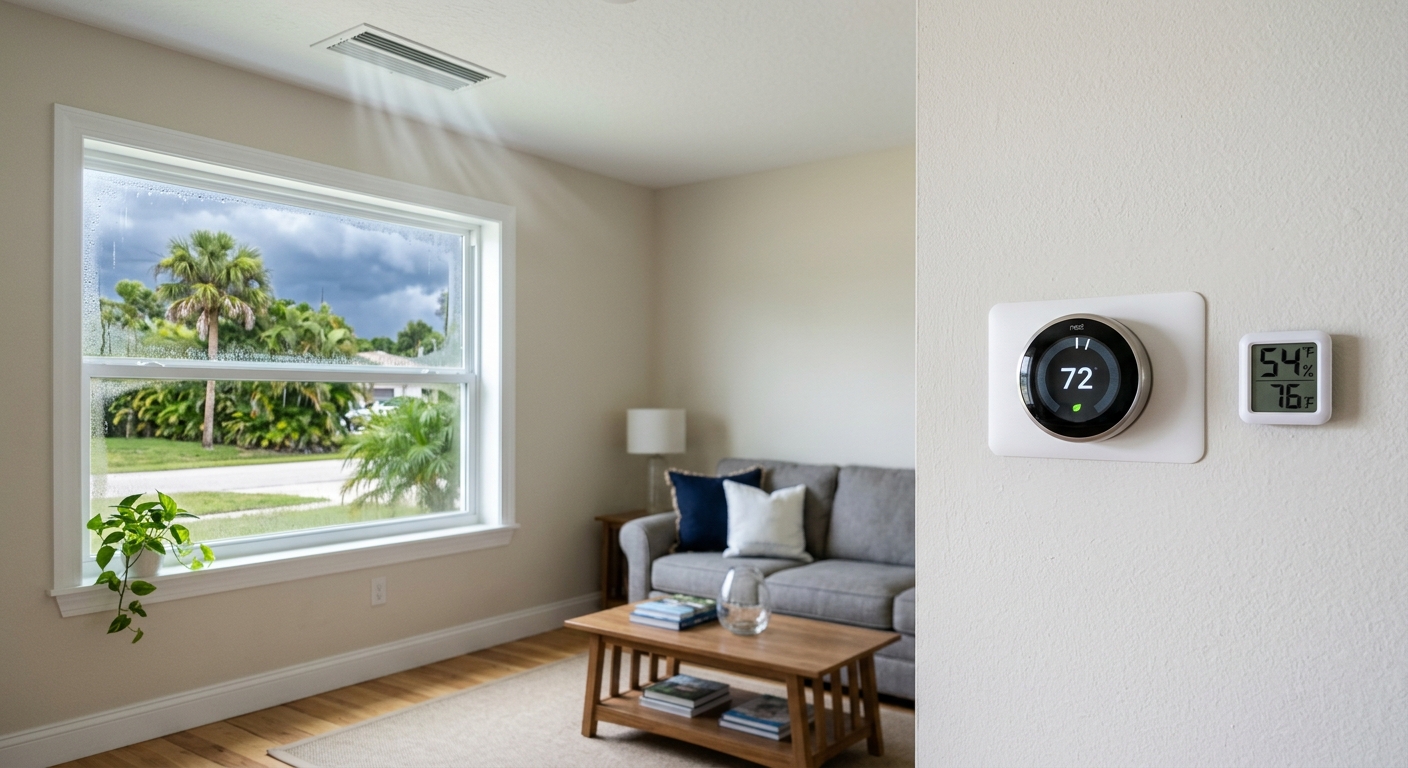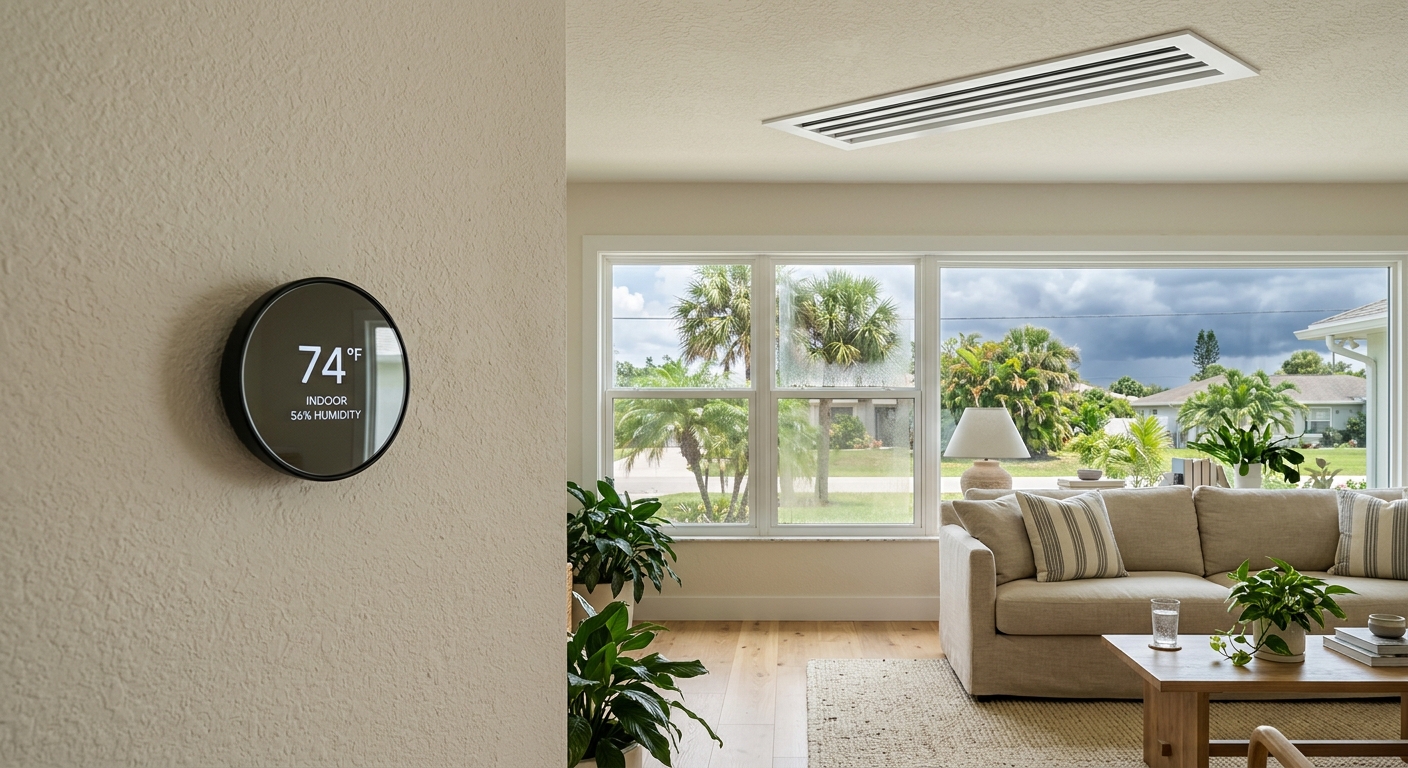
Why Is Florida Humidity So Uncomfortable Indoors?
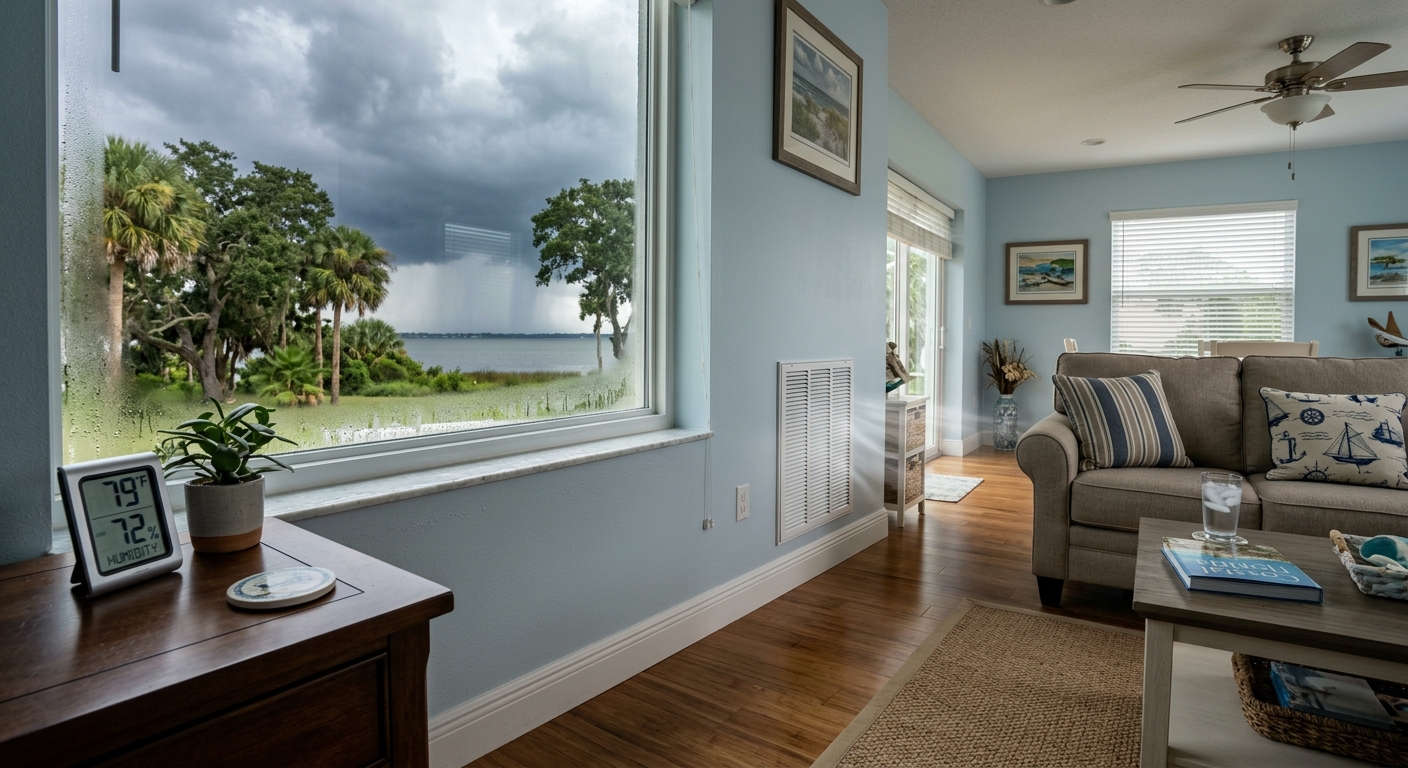
Discover what causes uncomfortable Florida indoor humidity and how Brevard County homeowners can reduce moisture without sacrificing comfort.
Florida indoor humidity feels uncomfortable when moisture accumulates faster than your air conditioner can remove it. In Brevard County, humid outdoor air, frequent storms, coastal conditions, air leaks, and short AC cycles can keep a home feeling sticky even when the thermostat shows a comfortable temperature.
The solution is to identify whether the moisture comes from normal weather, equipment operation, duct leakage, ventilation, or a building problem. Most homes should stay below 60% relative humidity, with roughly 45% to 55% providing a comfortable target for many Florida households.
Why does indoor humidity feel worse in Brevard County?
Relative humidity measures how much moisture the air contains compared with the maximum it could hold at the same temperature. Warm air can hold more water vapor than cool air, so the reading changes as temperature changes.
Brevard County regularly experiences warm, moisture-heavy air from the Atlantic Ocean, Indian River Lagoon, Banana River, and surrounding wetlands. Afternoon thunderstorms, long cooling seasons, and mild but humid days create conditions in which outdoor moisture can enter through doors, windows, attic penetrations, exhaust vents, and gaps in the building envelope.
Your body cools itself partly through sweat evaporation. When indoor air already contains substantial moisture, sweat evaporates more slowly. That is why a 74°F room at high humidity can feel warmer and more oppressive than a room at the same temperature with moderate humidity.
What is a healthy indoor humidity level in Florida?
A practical goal for many Brevard County homes is about 45% to 55% relative humidity. Brief increases during cooking, showering, or a summer storm are not necessarily a problem, but readings that remain above 60% deserve attention.
Persistent high humidity can contribute to musty odors, condensation, dust mite activity, microbial growth, and damage to finishes or furnishings. Extremely low humidity is rarely Florida's main concern and can also be uncomfortable, so the objective is moisture control rather than making the air as dry as possible.
Use a digital hygrometer to track conditions. Place it in a central living area away from supply vents, kitchens, bathrooms, exterior doors, and direct sunlight. A second meter near a problem room can reveal whether the issue affects the entire house or only one area.
Why is my house humid even when the AC is running?
Is the air conditioner cooling too quickly?
An air conditioner removes moisture when warm indoor air passes over its cold evaporator coil. The resulting condensation drains away through the condensate system. This process needs adequate runtime.
An oversized system may lower the temperature quickly and shut off before removing enough moisture. This is called short cycling. Oversizing is not the only possible cause, however; thermostat settings, clogged filters, equipment faults, and poor airflow can also produce short or ineffective cycles. Proper diagnosis requires more than comparing the equipment's tonnage with the home's square footage.
Is the thermostat fan set to ON?
During cooling season, set the thermostat fan to AUTO unless an HVAC professional has recommended another configuration. With the fan set to ON, it continues blowing after the compressor stops and may return moisture remaining on the evaporator coil to the house. AUTO allows the fan to stop between cooling cycles.
Could humid air be leaking into the house?
Outdoor air can enter through worn door seals, leaky windows, recessed lights, plumbing penetrations, attic hatches, and other gaps. Infiltration becomes especially noticeable after storms or on breezy coastal days.
Duct leaks are another concern. A leak on the return side can pull hot, humid air from an attic, garage-adjacent cavity, or other unconditioned space. Supply leaks can create pressure imbalances that encourage outdoor air to enter elsewhere. Duct problems may also cause uneven temperatures, excessive dust, or rooms that never feel comfortable.
Could everyday activities be adding too much moisture?
Showers, boiling water, indoor clothes drying, large aquariums, and unvented combustion appliances can add moisture. Bathroom and kitchen exhaust fans help only when they discharge outdoors and operate correctly. A fan that terminates in an attic can move moisture into a different part of the home rather than remove it.
Could there be a water or drainage problem?
High humidity may come from a roof leak, plumbing leak, damp crawl space, wet building materials, or water entering around windows and walls. An obstructed AC condensate drain can also cause water around the air handler. HVAC equipment cannot correct an active water intrusion problem, so the moisture source must be repaired.
How can I tell whether the AC or the house is the problem?
Start by recording indoor temperature and humidity at the same times each day for about a week. Note the weather, thermostat setting, AC runtime, showering, cooking, and any open doors or windows. This record gives an HVAC technician more useful information than a single humidity reading.
- Check whether humidity remains above 60% for long periods rather than only during brief moisture-producing activities.
- Look for condensation on supply vents, windows, pipes, or walls.
- Notice whether one room smells musty or feels damp while the rest of the house is comfortable.
- Replace or clean the HVAC filter according to the equipment and filter manufacturer's instructions.
- Confirm that the thermostat fan is set to AUTO.
- Check for visible water near the air handler, but do not open electrical panels or attempt refrigerant repairs.
If discomfort occurs mainly on mild, rainy days, the AC may not run long enough to provide much dehumidification. If humidity is high whenever the system operates, airflow, coil temperature, refrigerant performance, sizing, controls, or duct leakage may need professional evaluation.
What can homeowners do to reduce Florida indoor humidity?
- Keep exterior doors and windows closed when outdoor dew points are high, especially during summer and after thunderstorms.
- Run bathroom exhaust fans during showers and for about 15 to 20 minutes afterward.
- Use a vented kitchen hood while boiling water or cooking moisture-heavy meals.
- Avoid lowering the thermostat excessively. A colder setting does not guarantee better moisture removal and may create condensation on cold surfaces.
- Seal obvious gaps around doors and windows with materials appropriate for the location.
- Keep condensate drain outlets clear and schedule service if water backs up.
- Have damaged, disconnected, or poorly sealed ducts assessed by a qualified professional.
- Maintain the HVAC system so the coil, blower, drain, filter, and controls can operate as designed.
Humidity control also affects odors, airborne particles, and the conditions that allow biological contaminants to grow. Homeowners experiencing recurring dust, mustiness, or moisture concerns can learn more about Aquila's Indoor Air Quality services.
Do I need a whole-home dehumidifier in Florida?
Not every Brevard County home needs separate dehumidification. If the AC is correctly sized, the ducts are sound, and moisture sources are controlled, the cooling system may maintain an acceptable range during much of the year.
A whole-home dehumidifier may be worth evaluating when humidity repeatedly stays above 60%, especially during mild rainy weather when the AC has little reason to run. It may also help homes with challenging layouts, moisture-sensitive belongings, or recurring comfort issues after equipment and building problems have been addressed. Read Do I Need a Whole-Home Dehumidifier in Florida? for factors to consider before choosing one.
A dehumidifier should not be used to hide a roof leak, plumbing failure, wet crawl space, or major duct defect. Correcting the underlying source comes first.
When should I call an HVAC professional?
Schedule an evaluation when indoor humidity remains above 60%, the system starts and stops frequently, rooms feel clammy despite reaching the thermostat setting, vents develop condensation, or musty odors return after cleaning. Call promptly if there is water near electrical components, ice on refrigerant lines, a full drain pan, unusual equipment noises, or signs of active microbial growth.
A professional can measure airflow, temperature change across the coil, equipment cycling, duct pressure, drainage, and system capacity. If sizing is in question, the contractor should perform a load calculation rather than relying only on the size of the existing unit.
How can Aquila Air & Heating help?
Aquila Air & Heating serves homeowners throughout Brevard County and the Space Coast. Our team can evaluate persistent humidity, AC performance, drainage, duct concerns, and whole-home dehumidification options, then explain which findings require action and which do not.
If replacement is appropriate, ask about available systems and Aquila's Lifetime Warranty. Warranty eligibility, coverage, maintenance requirements, and terms should always be reviewed for the specific installation. Contact Aquila Air & Heating to schedule an indoor comfort assessment and find the source of your home's humidity problem.
Frequently asked questions about Florida indoor humidity
Is 60% indoor humidity too high for a Brevard County home?
A brief reading near 60% after a shower or storm is not automatically alarming. If the home stays at or above 60% for hours or days, investigate moisture sources, HVAC operation, ventilation, drainage, and air leakage.
Why does my Florida home feel humid at 72°F?
Temperature and relative humidity affect comfort independently. If the AC cools the house quickly without running long enough to remove moisture, a 72°F room can still feel clammy. Air movement and surface temperatures also influence how the room feels.
Should I open windows to lower indoor humidity?
Usually not during Brevard County's humid season. Opening windows helps only when outdoor air is genuinely drier than indoor air. On warm, humid, rainy, or coastal days, it generally adds moisture to the house.
Can a dirty AC filter cause high humidity?
A heavily restricted filter can reduce airflow and interfere with normal system performance. It may contribute to comfort and moisture problems, but it is not the only possible cause. Use the correct filter and have recurring airflow issues diagnosed.
Will a larger air conditioner remove more humidity?
Not necessarily. A larger system may satisfy the thermostat too quickly, resulting in shorter cycles and less moisture removal. Equipment should be selected using a load calculation that considers the home's construction, windows, orientation, leakage, occupancy, and other factors.