Why Does My House Feel Humid With the AC Running?
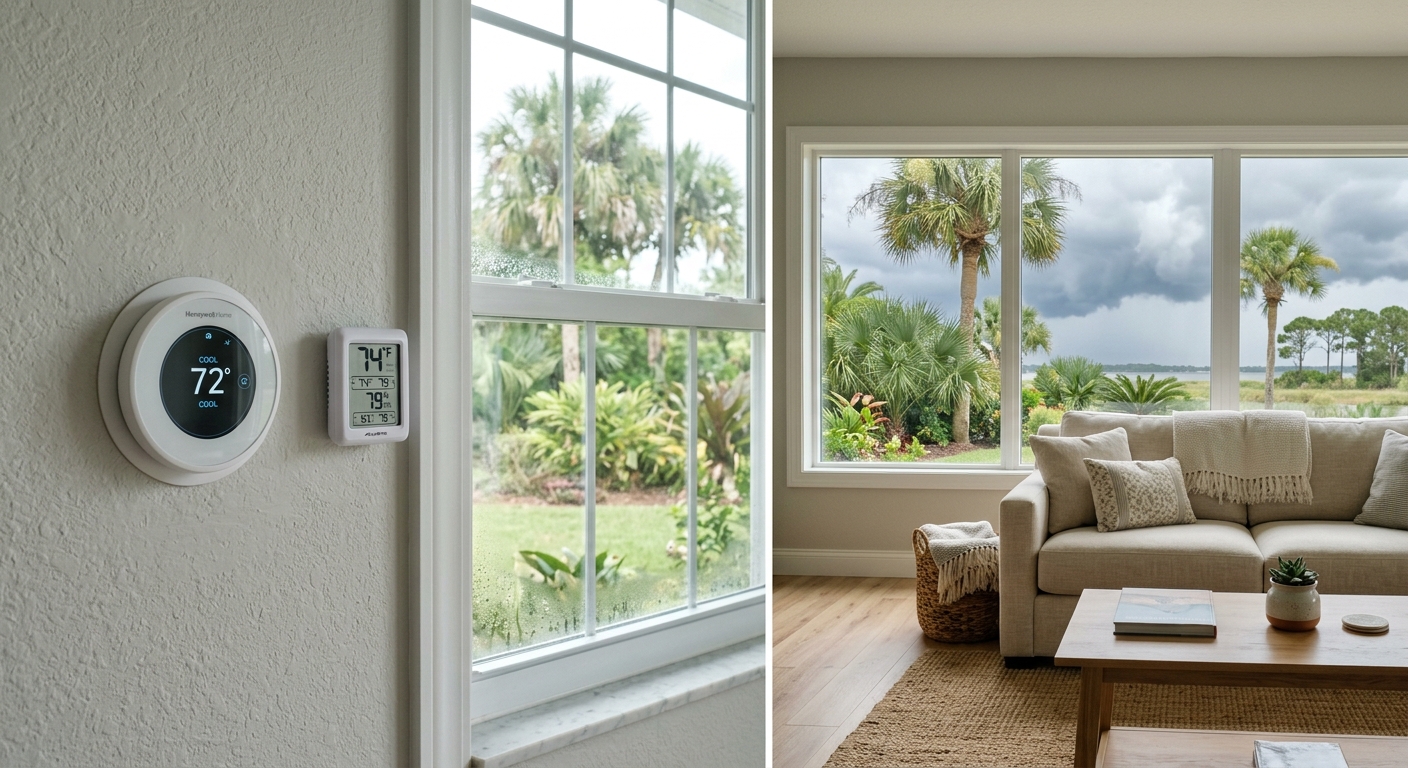
If your AC is running but your Brevard County home still feels damp, the cause may be short cycling, airflow problems, duct leakage, or excess moisture.
If your house feels humid with AC on, the system may be cooling the air without running long enough to remove enough moisture. Oversizing, thermostat fan settings, airflow problems, duct leakage, equipment issues, and Florida's heavy outdoor humidity can all contribute.
Start by checking the thermostat, indoor humidity, filter, doors, windows, and exhaust fans. If humidity remains near or above 60%, the AC short-cycles, or you notice musty odors, condensation, ice, or water around the equipment, schedule professional service.
How does an air conditioner remove humidity?
Your air conditioner handles two types of heat. Sensible heat affects the temperature you see on the thermostat, while latent heat is moisture suspended in the air. When warm household air passes over the cold evaporator coil, water vapor condenses on the coil, drains into the condensate pan, and leaves through the drain line.
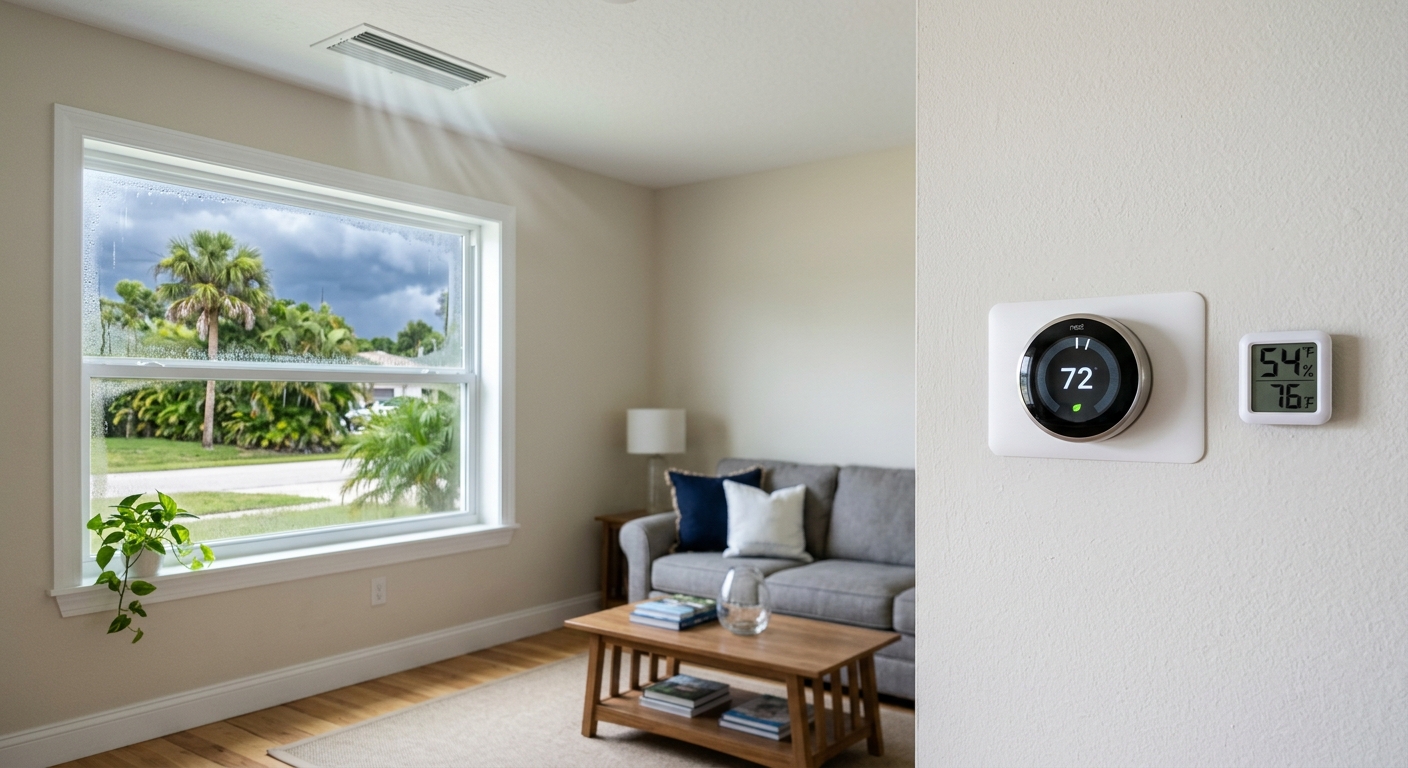
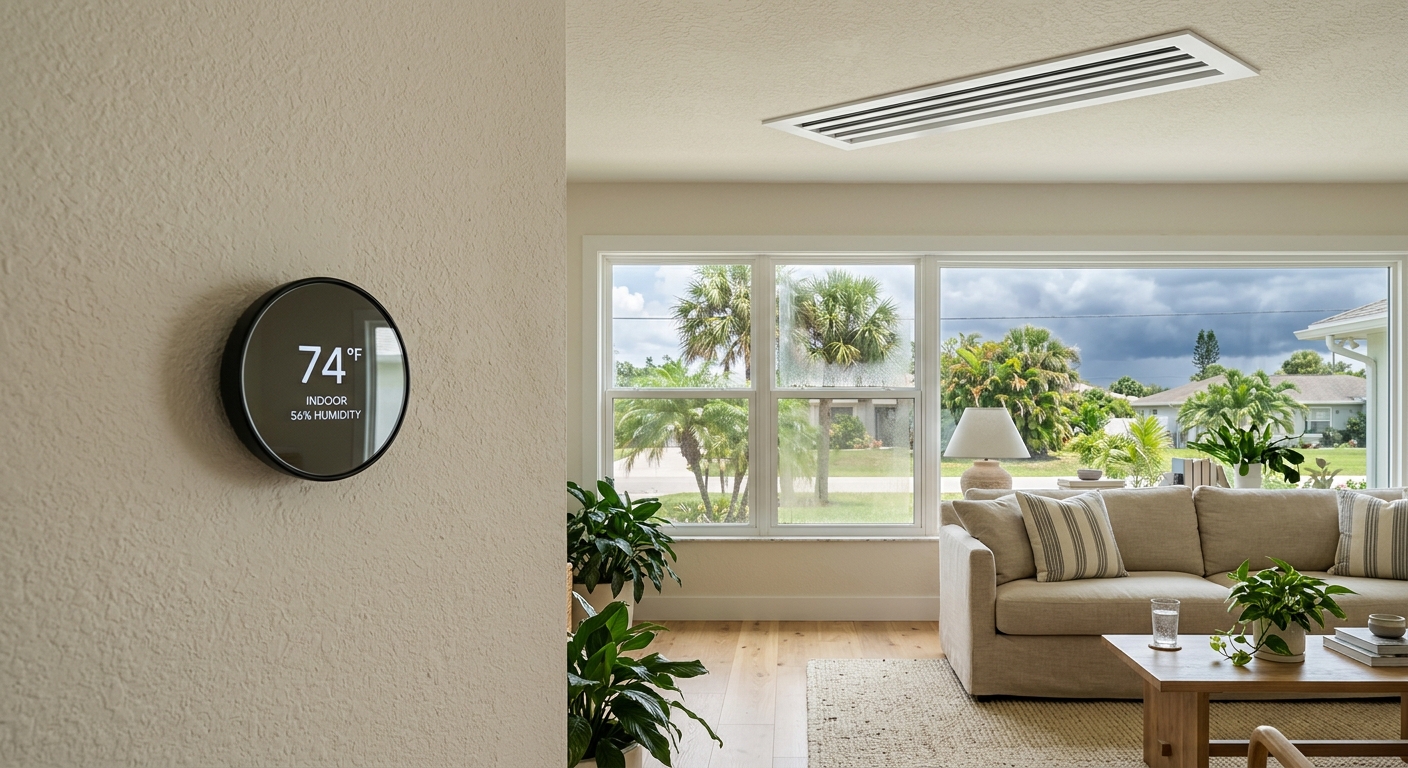
This process takes time. An AC can lower the temperature quickly but still leave too much moisture behind if its cooling cycles are consistently brief. That is why a Brevard County home may reach 74°F and still feel clammy.
For many Florida households, an indoor relative humidity range around 45% to 55% feels comfortable. Brief increases can happen after cooking, showering, or opening exterior doors. Sustained readings near or above 60% deserve attention because they can contribute to condensation, odors, dust mite activity, and unwanted microbial growth.
Is my AC too large for my house?
An oversized air conditioner is a common reason a home becomes cool but not comfortable. A unit with more capacity than the house needs may satisfy the thermostat quickly, shut off, and restart a short time later. These short cycles provide less continuous coil time for moisture removal.
Equipment should not be sized only by square footage or by matching the capacity of an old unit. A proper load calculation considers insulation, windows, ceiling height, orientation, air leakage, occupancy, and other features. Brevard County conditions, including intense sun, warm nights, and a long cooling season, also matter.
Do not assume that a larger replacement will solve comfort problems. A contractor should evaluate the home and perform an appropriate load calculation before recommending capacity. In some homes, variable-speed or staged equipment can provide longer, lower-output cycles that support better humidity control, but the application and setup must be correct.
Could the thermostat fan setting be making the house damp?
Check whether the thermostat fan is set to AUTO or ON. In most Florida homes, AUTO is the better setting for humidity control because the blower stops after each cooling cycle. With the fan set to ON, air may continue moving across a wet evaporator coil after the compressor stops, allowing some moisture to evaporate back into the house.
Some systems use a programmed blower delay or special humidity-control settings, so changing advanced settings without guidance is not recommended. If switching from ON to AUTO does not help, a technician can verify the thermostat configuration, blower operation, and humidity controls.
Can a dirty filter or airflow problem increase humidity?
Yes. Your AC needs airflow within the equipment manufacturer's specified range. A heavily clogged filter, dirty evaporator coil, blocked return, closed supply registers, or incorrect blower setup can interfere with cooling and moisture removal.
Airflow that is too low can make the evaporator coil excessively cold and may eventually cause ice. Airflow that is too high can reduce the amount of moisture that condenses as air passes over the coil. Because both extremes create problems, blower speed should be measured rather than adjusted by guesswork.
Homeowners can take several safe steps:
- Replace a visibly dirty filter with the correct size and an appropriate type for the system.
- Keep return grilles and supply registers open and unobstructed.
- Move furniture, curtains, and storage away from vents.
- Look for visible frost or water, but do not open equipment panels.
- Confirm that indoor and outdoor equipment can operate without blocked airflow.
If the coil is frozen, turn cooling off and arrange service. Running a frozen system can lead to water damage and additional equipment problems.
Are leaky ducts pulling humid Florida air inside?
Duct leakage can have a major effect in Brevard County because many duct systems run through hot, humid attics or other unconditioned areas. A leaking return can pull attic air into the system and distribute that moisture throughout the house. A supply leak can waste conditioned air and create pressure imbalances that encourage outdoor air to enter through cracks and gaps.
Warning signs include rooms that are consistently damp or difficult to cool, unusually dusty areas near vents, whistling sounds, loose or damaged duct connections, and temperature differences from one side of the home to another. A professional can inspect accessible ductwork and use diagnostic testing when leakage or pressure imbalance is suspected.
Why is humidity worse during rainy or mild weather?
Brevard County's coastal climate can produce high outdoor dew points even when temperatures are not extreme. During a rainy day, tropical weather pattern, or mild spring or fall period, the house may not gain enough heat to make the AC run for long. The indoor temperature reaches the thermostat setting, but the moisture load remains high.
Everyday activities add to that load. Showers, boiling water, drying clothes indoors, an unvented dryer, aquarium evaporation, and frequent door opening can all raise indoor humidity. Air leaks around exterior doors, windows, attic access panels, plumbing penetrations, and recessed fixtures may also admit humid air.
What can I do during a high-humidity weather pattern?
- Keep exterior doors and windows closed while the AC is operating.
- Run bathroom exhaust fans during showers and for about 20 minutes afterward.
- Use a kitchen exhaust hood that vents outdoors when producing steam.
- Confirm that the clothes dryer vents outdoors and that the vent is unobstructed.
- Avoid lowering the thermostat dramatically in an attempt to dry the home.
- Use a reliable hygrometer to track humidity in more than one room.
Lowering the thermostat may increase runtime temporarily, but it can make the house uncomfortably cold and does not correct the underlying cause. It can also create condensation risks on cold surfaces if humid air continues entering the building.
Could an AC malfunction cause high indoor humidity?
Several mechanical or setup problems can reduce moisture removal. Possible causes include low refrigerant charge from a leak, a dirty evaporator coil, improper blower speed, compressor problems, a faulty thermostat, or controls that cause short cycling. A poorly draining coil or incorrect equipment installation can also allow water to remain where it should not.
A clogged condensate drain usually shows up as standing water, leakage, or activation of a safety switch rather than humidity alone. However, any drainage problem should be corrected promptly, especially when equipment is installed in an attic where overflow can damage ceilings and insulation.
Refrigerant and electrical problems require trained service. Refrigerant is not consumed during normal operation, so a low charge may indicate a leak that should be located and addressed rather than repeatedly topped off.
Do I need a dehumidifier or an indoor air quality solution?
A properly sized and operating AC should manage much of a home's cooling-season moisture, but some Brevard County houses have moisture loads that justify dedicated dehumidification. This can be especially useful during mild, wet weather when the AC does not run long, or in tightly controlled homes that require planned ventilation.
A portable dehumidifier may help a single room, but it adds heat to that space and requires regular tank emptying or drainage. A whole-home dehumidifier can treat a larger area and coordinate with the HVAC system when it is correctly selected, installed, and drained.
Before purchasing additional equipment, identify air leaks, duct defects, ventilation problems, and AC performance issues. Aquila Air & Heating can also help you review broader Indoor Air Quality options based on the home's actual conditions rather than recommending a one-size-fits-all product.
When should I call an HVAC professional?
Schedule an inspection if indoor humidity stays near or above 60% for extended periods despite reasonable thermostat settings and normal household moisture control. You should also call if the system starts and stops every few minutes, runs continuously without cooling properly, produces weak airflow, freezes, leaks water, or leaves some rooms noticeably more humid than others.
Musty odors, recurring window or vent condensation, damp closets, or visible moisture staining also warrant investigation. If water is leaking near electrical components or through a ceiling, shut the system off if it is safe to do so and request prompt service.
A professional evaluation may include temperature and humidity measurements, airflow testing, thermostat checks, coil and drain inspection, refrigerant diagnostics, duct assessment, and a review of equipment sizing. These measurements help distinguish a mechanical fault from a building moisture or ventilation problem.
How can Aquila Air & Heating help?
Aquila Air & Heating is a family-run company serving Brevard County and the Space Coast. If your home feels sticky even while the AC is running, our team can evaluate the system, explain the findings, and recommend practical next steps based on your equipment and home.
Contact Aquila Air & Heating to schedule a humidity and comfort evaluation. If you are considering replacement equipment, you can also review our Lifetime Warranty information, including applicable terms and eligibility, before making a decision.